
Persistence, Complexity, and Power
Three pillars of the rational case for preserving wilderness

On May 10, I participated in a session titled “Saving What Is Left” at the Global Earth Repair Convergence, organized by Rob Lewis. I was there together with Rob and Susan Masino, and it was wonderful to meet, even if only online. Below are some of the thoughts I shared during the session. This is not a full-fledged essay but work in progress.
We are losing nature, and as a society we generally do not seem to care enough. From my corner of reality, I see clearly that this is profoundly wrong, and I am constantly looking for ways to explain why. I recognize some repetition in this blog’s title with a previous one, “Simplicity and Complexity, Doing and Non-Doing, Restoring and Preserving,” but I have kept thinking about this, and complexity is central.
What is Left?
By “what is left,” we mean natural ecosystems that still exist, seemingly for their own sake — ecosystems that are either not under direct human exploitation or, where exploitation has occurred, remain capable of self-recovery. This capacity for self-recovery is one of the defining features of wild nature.
In the forest zone, one useful operational measure of “what is left” is the concept of Intact Forest Landscapes (IFLs): large, unbroken natural landscapes showing no signs of significant human activity and large enough to maintain native biodiversity, including viable populations of wide-ranging animals. Technically, these are areas of at least 500 km², with a minimum width of 10 km.
The map below shows the remaining extent of Intact Forest Landscapes in 2025 and their loss over the preceding twenty-five years.
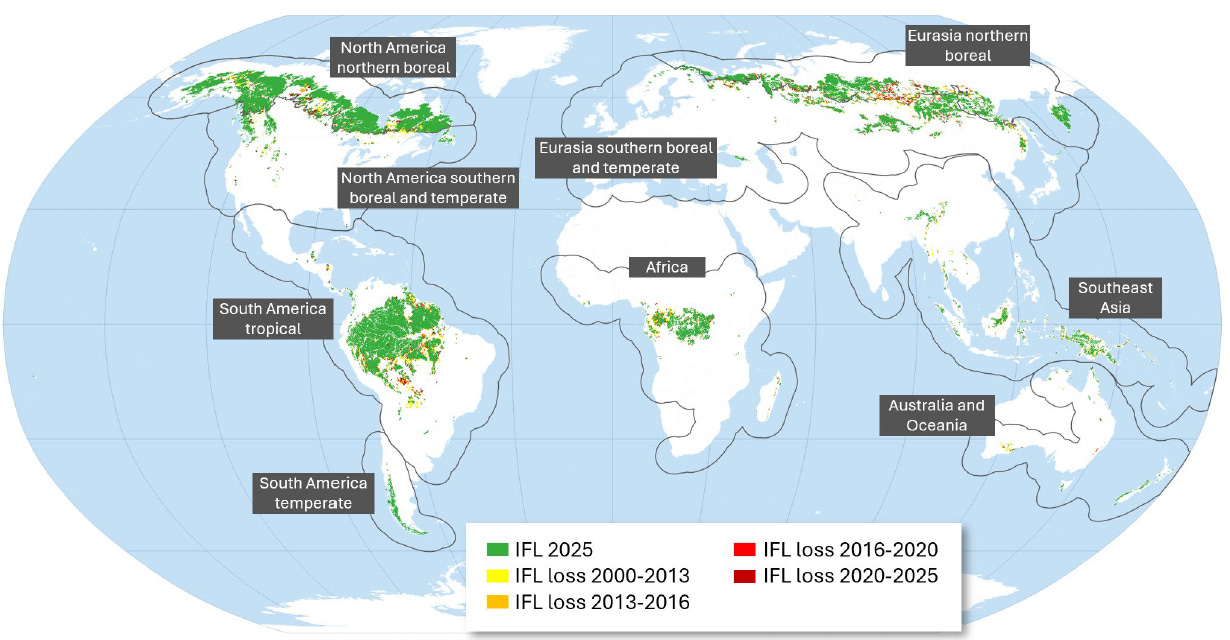
Fig. 2 from “INTACT FOREST LANDSCAPES EXTENT AND CHANGE, 2000-2025” by Potapov P., Turubanova S., Glushkov I., Zhuravleva I., Komarova A., Goldman E., Rosoman G., Yaroshenko A.: IFL extent for the year 2025, IFL area reduction from 2000 to 2025, and boundaries of geographic regions used for the analysis.
In 2000, the world still had about 12.8 million km² of such Intact Forest Landscapes. By 2025, this had declined to about 10.9 million km². What remains now occupies only 8.4% of the Earth’s ice-free land area and contains about 21% of global tree cover. Most of these remaining intact forests are concentrated in the Amazon and Congo basins and in the northern boreal forests, particularly in Canada and Russia. These remaining wild forests are our real treasure.
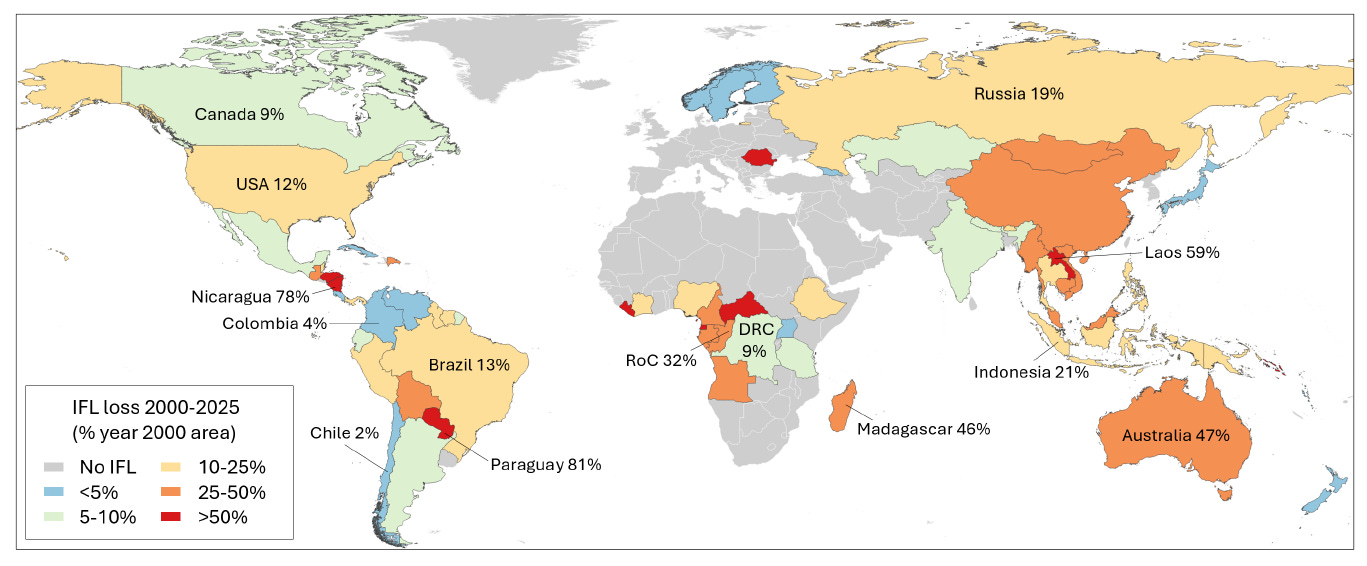
Fig. 5 from Potapov et al. 2025: IFL area loss 2000-2025 as a percentage of the year 2000 IFL area by country.
Viewing these maps invites numerous thoughts.
The red mark that catches the eye in Europe indicates the complete loss of Intact Forest Landscapes in Romania. There was not much there, and now there is nothing. Europe does not have much wilderness left, but it is still losing what is left.
At the same time, Europe has taken a visible course toward rewilding, and its initial efforts readily attract media attention. Restoration is valuable. But what does it tell us if we cannot preserve what we aim to restore? Can restoration become an illusion of doing — a way to avoid facing the truth that we remain unable to preserve what is left, or even to recognize its significance?
Another line of thought is more positive. Intact Forest Landscapes are not all we have. There are treasures invisible on this map: forests that were disturbed in the past but still retain the potential for self-recovery. Given time and protection, they may again become wild forests — not necessarily IFLs in the technical sense, but self-sustaining, climate-regulating ecosystems.
A conspicuous example is the return of old-growth conditions in parts of the eastern United States. The United States does not have much wilderness left, and the eastern part of the country has lost nearly all of its original old-growth forests. Yet forests that were cleared or logged in the past may, if left alone, continue along the long path toward old growth. What is left therefore includes not only the intact landscapes still visible on the map, but also the living systems whose self-recovery is still possible — if we do not interrupt it again.
Reason for Nature
Then one may ask: these natural ecosystems, existing by themselves — why should we protect them?
Some people do not need an answer to this question. They approach it on ethical and philosophical grounds. They believe that these ecosystems have the right to exist, and that this right must be respected.
Others approach the question emotionally and aesthetically: wild nature is beautiful, we love it — let it be.
But apparently there is not enough love or respect for nature among us to stop its destruction. Therefore, we need to broaden the support base for the conservation of wild nature.
I see my own mission as helping to do this on rational grounds. This is not to say that I am not emotional or philosophical in my attitude toward nature. However, emotions and philosophies differ greatly among humans, often dividing us more than contributing positively to our common cause.
The rational argument for preserving wild nature has, however, one non-rational premise: the one connected with the meaning of life.
Professor Victor Gorshkov, the founder of the biotic regulation concept and the scientist with whom I had the privilege to collaborate on the biotic pump concept, published a book in 2000 together with Vadim Gorshkov and me, entitled Biotic Regulation of the Environment: Key Issue of Global Change. It was a book about how life keeps the Earth habitable, written within the tradition of theoretical physics.
And theoretical physicists tend to seek a unified view of the evidence.
So, in this scientific book, there was an index at the end, where one could look up terms such as leaf area index, metabolic rate, greenhouse effect, and so on, each referring to particular pages in the book. And there was also an entry: “Life, meaning,” referring to pages 334–336.
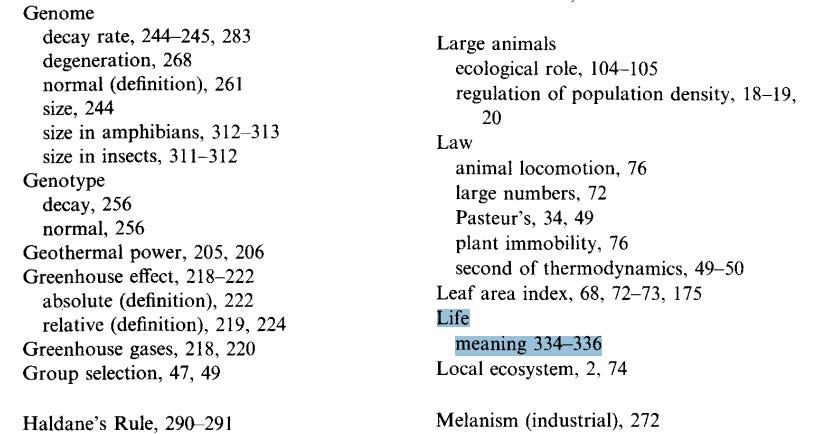
So now, if the meaning of life ever becomes unclear, you know where to look.
The meaning of life is the continuation of life — its persistence.
Once we agree that we want human life to persist into the future — and this is not itself a rational judgment — we can rationally justify preserving wild ecosystems as an indispensable condition for human persistence.
Persistence is therefore the first pillar of the rational case for preserving wild nature.
Complexity
Our next argument is about complexity.
Unfortunately, we have become used to simplifying — and oversimplifying — almost everything: reducing the problem of climate stability to carbon dioxide concentration, or the problem of obesity to Ozempic. Our tactical solutions are often highly sophisticated, but our strategic thinking remains shallow.
This reflects a one-dimensional mode of existence associated with expansion. Humanity has been expanding into the biosphere, destroying living capital. This one-dimensionality makes our strategies primitive: more extraction, more production, more control, more replacement.
Conversely, if we are to live in a steady state, without the progressive transformation of the planet and without the expansion vector, then our strategies for living must become far more sophisticated — and far less obvious. We would need to learn not only how to act, but also how to refrain from acting; not only how to restore, but also how to recognize what must be left alone.
And this would require us to redefine what human progress is, what knowledge is most valuable, and how that knowledge should be judged.
So, if we imagine that we are already those advanced humans of the future — highly skilled in appreciating complexity — the first thing we notice about climate is that it is dynamic, not static. Its state emerges as the outcome of many processes, often acting in opposition to one another.
What would climate be without these dynamics? On an airless, stone-covered planet, surface temperatures would respond far more directly to incoming sunlight and radiative cooling. Earth’s habitable climate is not only a matter of composition; it is also a consequence of circulation, condensation, heat transport, and the living processes coupled to them.
For clouds to form and reflect sunlight, air must rise, cool, and water vapor must condense. Atmospheric motions transport heat upward, while atmospheric and oceanic circulation redistribute heat from the equator toward the poles, shaping where and how this heat escapes to space.
What do I mean by processes acting in opposition to one another? Take atmospheric composition, for example.
The Carbon Cycle
The atmosphere contains nearly one thousand gigatons of carbon. Every year, more than one hundred gigatons of carbon are taken up by the terrestrial biosphere through photosynthesis, while a comparable amount is released back through the respiration and decomposition of countless living beings.
So any serious disruption of these processes could rapidly perturb atmospheric composition — just as we humans have done by suddenly burning organic carbon that had been buried underground for millions of years.
But the functioning biosphere does not simply push this enormous flux in one direction. The opposing processes of synthesis and decomposition are immensely powerful, but they are kept in check. They form not a static balance, but a dynamic one — a balance maintained by life itself.
Unfortunately, the role of the biosphere in the carbon cycle has often been studied within oversimplified frameworks. As a result, despite decades of research, we still do not fully understand how major carbon pools and sinks are changing.
A common premise has been that the carbon value of trees must be expressed through carbon accumulation in their biomass — although, evidently, trees cannot accumulate carbon indefinitely.
Much larger reservoirs of organic carbon than living tree biomass are found in soils and as dissolved organic carbon in the ocean. Yet we still lack robust knowledge of how these immense pools respond to the continuing transformation of the biosphere.
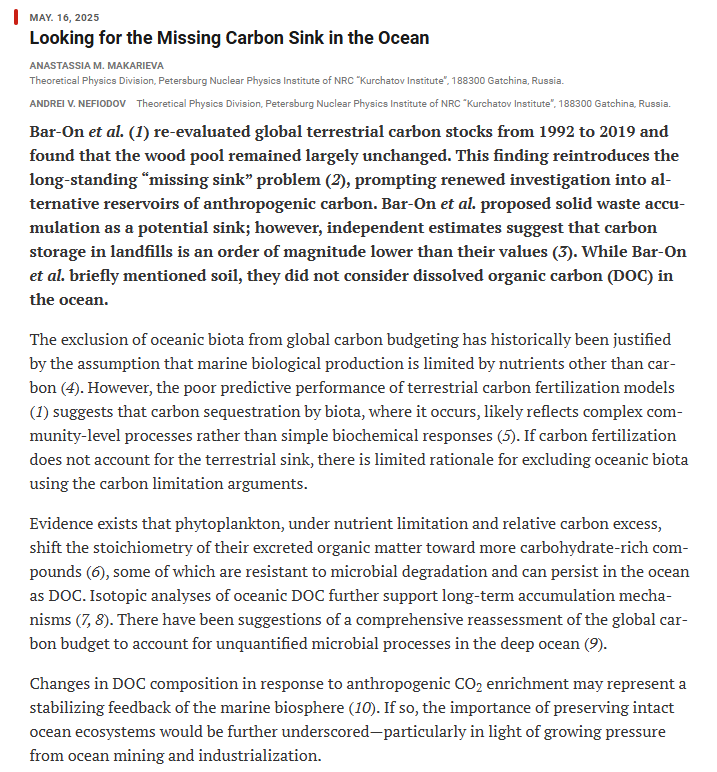
Our eLetter on Bar-On et al. 2025 — bringing the oceanic ecosystem into focus
What we do know is that, so far, on the global scale, land and ocean sinks have responded to anthropogenic carbon emissions in a compensatory way: they have absorbed a major share of our emissions. This does not follow from any simple first principle — except from the biotic regulation concept, which maintains that the biosphere organizes its own homeostasis.
Imagine, instead, that we had found the opposite: that natural ecosystems globally were releasing additional carbon, as degrading lands often do. Our mechanistic understanding would likely explain this a posteriori: the planet warms, soils warm, heterotrophs respire faster, and extra carbon is released.
Indeed, even within current modelling frameworks, different assumptions about the response of soil microbes to warming lead to radically different projections of soil carbon loss.
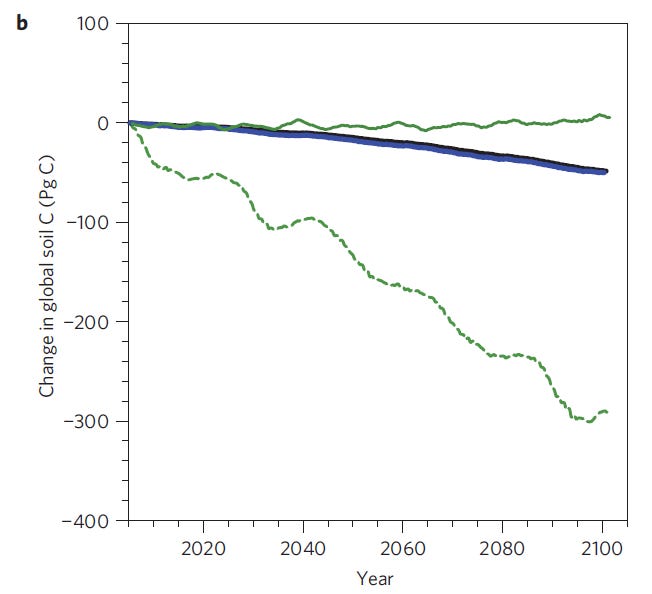
Modelled response of global soil carbon to warming in conventional soil-carbon models and in a microbial-explicit model. In the dashed green scenario, microbial communities adapt to warming without a decline in microbial growth efficiency, resulting in substantial soil carbon loss. Source: Wieder, Bonan and Allison (2013), Fig. 3b, Global soil carbon projections are improved by modelling microbial processes, Nature Climate Change.
But the remarkable fact is that, so far, the living Earth has been compensating for part of our disturbance. This compensation is not guaranteed. It depends on the continued functioning of ecosystems that are still intact enough to compensate for disturbance rather than amplify it.
This is why complexity matters. When we destroy a natural ecosystem, we are not merely removing a stock of carbon. We are dismantling part of a dynamic living system whose regulatory functions we do not fully understand, cannot reproduce, and may already depend on for our own persistence.
Water Cycle
Another example of tightly coupled opposing processes is the water cycle on land. Plants require water to perform photosynthesis. The opening of stomata needed for carbon dioxide uptake is accompanied by transpiration, during which large amounts of water vapor are released into the atmosphere. Thus, photosynthetic activity is coupled to depletion of local soil water.
In a dry regime, where vegetation is sparse and the atmosphere remains relatively dry, additional transpiration may exceed any associated increase in precipitation. Vegetation then appears to reduce water availability: more greenness means less runoff.
But this is not the only possible regime. As vegetation develops and transpiration moistens the atmosphere, precipitation may begin to respond more strongly. In a wet forest regime, increased transpiration can be coupled to increased moisture convergence and rainfall. More vegetation can then mean not less, but more available water.
Thus, the same process — transpiration — can appear either as a loss of water or as part of a mechanism sustaining abundant rainfall, depending on the state of the ecosystem and atmosphere. A disturbed ecosystem in a dry regime cannot reveal the full hydrological function of an intact wet forest. [see “Ecosystem Recovery, Atmospheric Dynamics, and the Water Cycle”]
Power
The third argument — historically, the first — comes from Vladimir Vernadsky: seen against the background of geochemical processes, and even of anthropogenic environmental impacts, the processes of the biosphere are immensely powerful.
Vernadsky's obscurity in the West is surely one of the great examples in history of a political impediment to the spread of scientific information. But like the periodic table of elements, which, in the United States, is still seldom credited to its Russian inventor Dimitri Mendeleev, Vernadsky's ideas became widely known even though they were not attributed to their author.
L. Margulis et al. 1998 Foreword to "The Biosphere" by V.I. Vernadsky
Evidence of the greater resilience of intact ecosystems brings Persistence, Complexity, and Power together in one observation. It is a very important line of evidence in favor of biotic regulation. When an ecosystem that has maintained itself over immense periods of time is arbitrarily modified, its function may rapidly deteriorate. This is what we should expect when we intervene in something whose functioning we do not understand in full — precisely because its complexity exceeds ours.
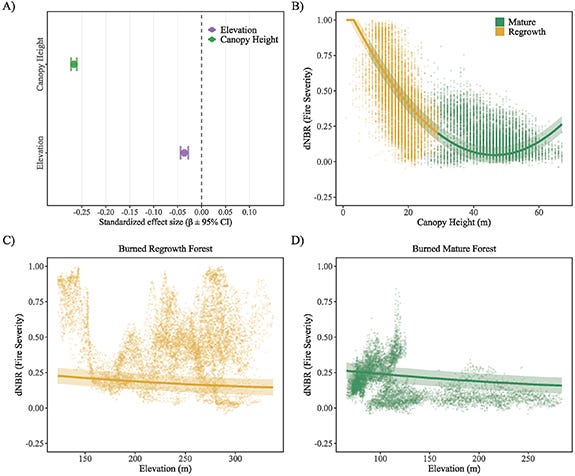
Data from Bowman et al. 2026 illustrating that young tree stands that form after logging are more susceptible to fires than mature forests.
The opposite of resilience is fragility. One way to see this fragility is through turnover times: by comparing the size of an environmental reservoir with the magnitude of the fluxes running through it. When the fluxes are large relative to the reservoir, a loss of regulation can change the state of the system very rapidly.
For atmospheric carbon, the turnover time with respect to biospheric exchange is about ten years. For modern groundwater stores on land, the turnover time with respect to global river runoff is also short — about six years.
These are almost instantaneous timescales compared with the millions of years over which ecosystems have persisted. The contrast is sobering: variables that make the Earth habitable can change very quickly, while the living complexity that keeps them within viable bounds has taken immense time to evolve and cannot be rebuilt at will.
Therefore, the rational case for preserving wild nature, as I see it, rests on three pillars:
Persistence — Complexity — Power
By persistence, I mean the continuation of life, including human life, into the future.
By complexity, I mean that conditions suitable for life are not maintained by one variable, one mechanism, or one technological fix. They emerge from the interplay of many dynamic processes — physical, chemical, and biological — often acting in opposite directions.
And by power, I mean that life is one of the strongest forces shaping the Earth system, capable not only of transforming the environment, but also of maintaining it in a state suitable for life.
To keep such powerful, complex, multidirectional processes within the narrow range compatible with life requires complexity of the same order. Natural ecosystems possess this complexity, but we will never know it in full detail. When we disturb this complexity, we impair function. And when we impair function on a large scale, we risk destabilizing climate.
Therefore, the evidence for the importance of natural ecosystems does not come primarily from how they affect one parameter that currently seems most important to us — for example, carbon stored in tree biomass. It comes from a deeper observation: the equilibrium that sustains life is dynamic, fragile, and maintained by life itself.
The more we understand the Earth system, the less plausible it becomes that we can dismantle its living complexity and still keep its stabilizing function.
Related reading:
Information processing by natural ecosystems

Our attention is increasingly focused on the importance of computation. We are told that the one who computes more wins. To compute is to have an algorithm to which you feed some initial numbers, and which, after some operations, gives you another set of numbers that suit your goals. Often we find that this is about war: you feed the coordinates of enem…
I have been wrestling with the notion that the irregular nutrient pulses in the broader ocean are now lost from the biological pump of bioaccumulation due to them having quicker degradation times than a depleted environment can capture and use them. I wrote a short piece explaining how Instead of adding the nutrients and the problems associated with this, we prime the system for the capture of these pulses we may have a much better and cost effective safe route for ocean regeneration.
River systems on this planet are equally important to Earths healthy climate and environmental infrastructure. They are no different in their ability to provide services as do our forests.
Rivers that have been fragmented, detained, and dammed even for short periods of time have been severely injured in their ability to serve the Earth as an essential part of our planets infrastructure that maintains climate and healthy environment for llife
At present almost all out planets major waterways have been obstructed and fragmented to one degree or another. Until we gain some depth in understanding the the role MOVING WATER plays on our planet we will continue pouring large quantities of heat through water vapor and evaporation into our atmosphere. And at the same time some people call hydroelectric clean and renewable energy. This is nothing more than an illusion! An illusion mainly effecting science