
Simplicity and Complexity, Doing and Non-Doing, Restoring and Preserving
A StoryMoss conversation with John D. Liu and Anastassia Makarieva, in anticipation of the Global Earth Repair Convergence

The Global Earth Repair Convergence is already underway in Port Townsend, Washington, on the Olympic Peninsula, 7–11 May 2026. I am grateful and excited to contribute to Rob Lewis’ session, Saving What’s Left: Why Earth Repair Also Means Land Protection, and especially happy to be joining Susan Masino in this conversation.
In anticipation of the Convergence, I was delighted to be interviewed together with John D. Liu — one of the world’s most eloquent voices for restoring degraded landscapes and rethinking human civilization around ecological function — by Emmanuelle Chiche and Megan Lindow from StoryMoss. Below is a slightly abridged transcript of the interview, which can also be watched on YouTube.
Restoration and preservation of nature form a philosophical Möbius strip, weaving into deeper questions about our existence — and, as I see it, not without controversy.
Opening: Different Paths Converging Around Nature
Emmanuelle:
Hello, StoryMoss viewers. Hello, John, Anastassia, and Megan. We are really, really happy and honored to be with you today as we invite more of the world to join the Global Earth Repair Convergence, founded by Michael “Skeeter” Pilarski, happening in early May in Cascadia and online.
We thought of inviting both of you for what may perhaps be the first one-on-one conversation with us in the background about your amazing work.
Anastassia Makarieva is a Russian atmospheric physicist and one of the originators of the biotic pump concept and the biotic regulation framework, which offer essential insights into healing our degrading world. John D. Liu is a filmmaker, activist, land restorer, and so many other things. Thank you both very much.
Megan is joining us from Cape Town, while John is in Los Angeles, Anastassia is in Russia, and I am in New York. We are here together today. Megan?
Megan:
Yes. Hello, everyone, and welcome. We are going to have a story-weave today.
I wanted to ask both John and Anastassia, first, what draws you specifically to the Global Earth Repair Convergence. Beyond that, as we were just noting in our discussion, so much of your work, Anastassia, points to the need to preserve ecosystems — these complex forests that remain around the world even as we are seeing such rapid rates of destruction and deforestation.
And John, as a filmmaker with a long background of discovery — from traveling as a journalist to really learning about natural processes and ecosystems, and then weaving that knowledge into large-scale efforts at landscape restoration — you come to this restorative work across landscapes that have already been disturbed, and from a background of covering politics and geopolitics.
So, as each of you tells us a little more about your work, I would also love to hear what fascinates you most about each other’s work, and what you are hoping to explore and discover in this conversation.
Maybe we can start with you, Anastassia.
Anastassia:
Thank you, Megan. It is my great pleasure to be here.
I have been working all my life as a physicist, investigating the role of natural systems in sustaining a habitable climate on Earth. In this habitability, water is a key ingredient. Much of my recent work has therefore been devoted to investigating the role of terrestrial ecosystems in facilitating the water cycle on land, particularly its atmospheric component: moisture transport from ocean to land.
The biotic pump concept, which Emmanuelle mentioned, describes the active role of natural vegetation in driving the water cycle — particularly in ensuring that moisture evaporated over the ocean comes to land, precipitates over land, and feeds the water cycle and all life on land.
This is largely theoretical, fundamental research. What fascinates me in John’s work, as you said, is that these are real efforts to which our knowledge could contribute. This knowledge can be spread and converted into real actions that engage people all over the world in a network where they stop destroying and begin doing something more positive, coming into greater harmony with nature, which I believe is our future.
Megan:
Thank you, Anastassia. John?
John:
Thank you very much. It is a great pleasure to have this opportunity to speak with you all.
I certainly came from a different beginning point. I was really a professional observer for my entire life. I tried to tell the truth and to understand what I was seeing at any given time.
It was very exciting and interesting to watch major political events, economic developments, cultural changes, and so on over the course of my life. But when I found that the Earth systems were massively degraded in all the cradles of civilization, and I had the opportunity to go to many of these places, I began to look at them and consider what I understood of the history — or what I could find out from the history, from sediment layers, from fossil remains, and from what was already known.
I began to realize that I had very little information about this. I thought I was fairly experienced and educated, but there I was, looking at the basis of living systems, and I did not really know enough.
Then I was very fortunate. I was asked by the World Bank to film the baseline study of the rehabilitation of the Loess Plateau in the upper and middle reaches of the Yellow River. In doing that, I realized that it could not always have been the way it was. I had to do a kind of forensics: to look at the crime scene and say, “Well, I see the body, I see the blood, and now I’m looking for whatever instrument was used to murder this thing.”
Ultimately, what I found was that I was studying dysfunction. It was necessary to understand the dysfunction fully if I wanted to see it another way. From my position as an observer, I was in some ways representing humanity, because humanity was not aware of what was going on. For thousands of years, human beings had been destroying the life-support systems of the planet.
I was given many fellowships to study, so I became an accidental student. I started to realize that this could be defined if we used these forensic methods to look at what had happened.
I found that all fully functional places have massive biodiversity. They have higher and higher canopies. Perennial polycultures replace annual plants, and there are no exposed soils whatsoever. In a functional terrestrial system, unless you have plate tectonics, earthquakes, volcanic activity, meteor strikes, or something like that, you generally have total vegetative cover.
There are some interesting differences in some deserts, but my conclusion is that most deserts are not natural deserts.
The Chinese experience in restoration shows very quickly that restoration can go faster than we thought. Maybe we really need to go to the worst places — the most degraded places, where early civilizations began and destroyed their environments. That also links with some permaculture understanding: you have to work at the edges. The edge is where there is a lot of variation.
One of the biggest realizations for me was that the percentages and total amounts of what I would call necromass — decaying dead biomass — are critically important. Almost nobody knew anything about this. This dead biomass is also the habitat for the microbial and fungal communities that make mineral nutrients bioavailable to plant life.
Another important point, which I think is very close to what Anastassia is working on, is that once you have degraded the system, you find that biology had self-organized over prodigious time to alter the physics.
As soon as you destroy the biology, you alter the physics.
Then all the criteria become larger and larger: the temperature differentials, for example. I have seen temperature differences of 45°C between exposed soils in deserts and areas beneath artificially induced vegetative cover. That cover was grown through extreme methods: saline irrigation and the use of halophytes. But it was functional, and it worked.
If we can do that, we can hold moisture in the lower hydrological cycle and recycle it near the Earth. Looking at this, it struck me that this is exactly what needs to be done. Every human being needs to understand that we are in a symbiotic relationship with all other life forms. It is ridiculous for us to imagine that our abiotic infrastructure is the basis of life. It is not.
I am talking too much. Sorry.
Complexity and Simplicity
Megan:
No, it is fascinating. I am really appreciating this aspect that I have heard from both of you, in different ways, about the human relationship to the natural world, and how we need to grow our understanding and heal our hearts at the same time in order to achieve what we are all gathering for — both in place and online — in this Global Earth Repair Convergence.
There is so much knowledge emerging. But I want to turn the conversation a little poetic for a moment, if I may. I was inspired by hearing both of you speak in various recordings about your work.
I wanted to ask whether you could each talk about an experience you have had in the natural world — an experience of very deep connection — and what insight that brings you about repair and going forward. I know you must both have innumerable such experiences, but perhaps, Anastassia, you could begin. How does it feel when you stand in one of these vast forests in Siberia, or at the river, and see what your work has uncovered — the flying rivers, the biotic pump, the physics actually happening in this place?
Anastassia:
Thank you, Megan.
John mentioned that he traveled a lot, saw many ecosystems, and learned from them. Personally, I have spent a lot of time in boreal forests — many years, if I count all the months together. So I also have this first-hand experience of how nature works.
Unfortunately, not many people have this. What I would say is important is that when you are there, in what John refers to as a functional ecosystem, you understand that it is very complex. It is basically the most complex thing or process that one can imagine.
When you see this, it sets a standard for understanding complexity: what complexity is, and what complexity is required for function.
The challenge is how to communicate this idea of complexity to people who have not seen it first-hand, and who may believe that we can simply put a green thing in a pot, bring it to the desert, water it, and then something will start going there.
This complexity — I do not know how to express it in poetic terms — is a very profound feeling. It is overwhelming. This is what I am trying to bring into my scientific research: to formulate it in scientific language so it can be understood and shared by all people.
So this is my response: complexity. The unmatched complexity of the living world.
Emmanuelle:
That is beautiful. Thank you so much.
As we were preparing to meet with you and watching many more recordings, we were going slowly, trying to get the depth of your inquiry. For StoryMoss, going back to Joanna Macy’s work on deep ecology — opening our hearts, paying more attention, and listening — I think that is what Megan was trying to bring in with the poetic question.
I have been reading a lot of both of your work. There is a lot of eco-philosophy, critical wisdom, mindfulness, and the stage where many more of us, when we reach that moment, begin to pay more attention and engage. We begin to feel that we can do something.
I think the problem is that too many of us think we cannot do anything, that we are doomed. But both of your work brings hope — active hope. That is what we are also trying to bring through the complexity.
John, did you want to respond?
John:
Yes. I would like to say that I agree: the complexity is infinitely complex. But there is also a very elegant simplicity in nature, which is quite beautiful when you find it.
Nature follows a logic. Ecology and logic are closely related, and that is really important. What we see now with our economic and political systems is that they are extremely illogical. They are about power, dominance, or greed. These are not very wise perspectives.
I would also like to say that many people consider that we are physical beings struggling or striving to have spiritual experiences. But it seems more likely that we are spiritual beings experiencing physicality for a short while.
In doing this, it shows us a bit of a purpose in life: we are meant to bring life, to bring consciousness to life. We are just not very good at it yet. We have been expressing ourselves more like parasites, as if we are going to destroy our host and then die with the host. That is ridiculous.
Likewise, the idea that we should acquire more and more material possessions or power for ourselves is a mistake. As a journalist, in all my observations, I noticed that we are all going to pass away. We will return to where we came from. The person who dies with the most stuff does not win anything.
There is a mistake here. I think it is also about joy and beauty. What we see in nature has such elegance and beauty. What I see now, even here in Los Angeles, in many films for example, rarely shows tremendous beauty or profound thought. They are mostly violent, or about greed, or about more things, grasping, and low-energy behavior.
I think we can do better. We should do better. We are supposed to do better. We have all the information we need now. We have the ability to feed everyone on the planet. I do not think that is a problem if we share and work to do this.
But if we think that the basis of wealth is material things, then we are bound to fail. It will be very difficult to take care of eight, nine, or ten billion people. But if we understand that nature is expressing perennial polycultures and consistent, self-replicating life — that it is breathing, and because it is breathing, we are breathing — then we realize we are part of it. We are a bivalve. We could act as any other organism that breathes, or filters the water, or takes in food.
And it has to be organic — without poisons, without pollution. It is insanity not to do that.
So I think we have enough information. We have our marching orders. We have work to do, and this needs to be the central intention of human civilization.
Doing and Non-Doing
Megan:
When you mention breathing, I want to pick up on that. When I was discovering your work, Anastassia, I had the impression of the forest — the biotic pump — as the forest breathing in a way, generating its own self-sustaining water cycles.
To return to the really complex nature that you both speak about, and the challenge of how humans learn this complexity when not everybody has the opportunity to experience it: at the same time, there is so much that we know now. Some of it is perhaps ancient knowledge that has been lost through modernity, colonization, and other processes of destruction.
That brings me back to the inspiration and active hope that need to come with this challenge: stepping up, doing things differently, and integrating this understanding that we are developing as humanity.
If either of you has a response?
Anastassia:
If I pick up from breathing: actually, the biotic pump has also been compared to the beating heart of the forest, because it pumps like a heart. It pumps moisture.
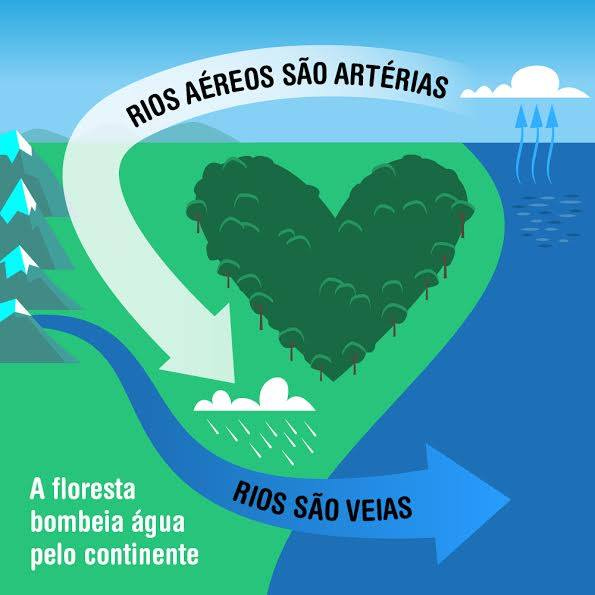
But I would also like to bring in the idea of balance. John mentioned complexity, simplicity, elegance, and logic in nature, and I totally agree. Another perspective I would like to emphasize is doing and not doing.
People are doers. We can easily be energized for a good cause — to do something, to plan things, to restore. But another important thing is not doing what should not be done.
Once we energize ourselves to restore something that we have destroyed as doers, we must at the same time put limits on further destruction of this water pump — this still-beating heart of the world’s great forests: the Amazon, the Congo, Indonesia, Papua New Guinea, Canada, Russia. These forests are alive. They have been exploited and are being exploited, but they are still alive. They can regenerate, and they can teach us this complexity, simplicity, and elegance.
We will not invent it. We should not be too self-confident. We cannot invent nature. But we can learn, and we can let nature guide us through self-restoration.
Key priority is to let what still remains persist into the future.
We must stop the destruction. Doing and non-doing: that is what I think.
John:
What she said.
Megan:
Beautiful.
Emmanuelle:
Yes. John, do you want to take this on?
The Ability to Understand
John:
One thing crossed my mind because Anastassia said many people might not have this experience. I am not sure that is true.
I remember having a fellowship at Rothamsted Research in the UK, an agricultural field station. They created the RothC carbon model, which is part of the basis for understanding disruptions to the carbon cycle.
The director invited me to come. He did a lot for me. He sent me to Africa, and I was able to really see the Congo Basin and work closely with a number of countries there for a while.
What was very interesting was that I had to give a lecture. They had all these quite famous scientists, and I was wondering what I would do if I gave this lecture and they just looked at me. I did not really know what it would be like.
When I gave the lecture, at the end a rather well-known scientist came up to me and said, “Hello.”
I said, “Hello.”
He said, “You seem to know what you are talking about.”
I said, “Well, thank you.”
Then he said, “If you can understand it, anyone can understand it.”
And I thought: yes, that is true. If I can understand it, anyone can understand it.
That is where we need to be. This needs to be common knowledge throughout humanity: we are drinking water, we are breathing air, and soils are the basis of the food we eat. These systems need to be fully intact. Biodiversity is normal. Reducing things to monocultures is unknown in nature. Nature is outrageously biodiverse.
Because of the symbiosis between systems, we are killing ourselves if we destroy them. Once we understand this, we must see that wealth in the world does not come from buying and selling things. It comes from the natural functioning of Earth systems.
Every living being has the right to life. It is outrageous to imagine that we should decide, with prejudice, what lives and what dies. If you understand how extinction events work, you find that the top of the food chain is most at risk. That should give us some thought, because we are at the top of the food chain. It is outrageous that we could even be in a situation where this is possibly happening.
The anger and painful sorrow that are around all the time — this is not natural. You do not find that when a baby is born and looks at the world, fascinated by everything. This is taught behavior. We should be really careful to teach joy and the harmony that exists among all life. That is where we need to focus.
One thing we have been working on recently — over the last nine years — is ecosystem restoration communities. What we are seeing is that people can come together and work together. When they do, they can do more than they can as individuals. They can study together and understand together. Physically, mentally, imaginatively, and intelligently, together we are stronger.
By ourselves, how are we going to restore the Earth? The problems are huge. But if you think about them the way the Chinese think about them, you say: “Okay, we are a swarm. We are a hive of bees. We are ants. An ant can only carry a tiny thing, but when all the ants come together, they can pick up everything.”
Then you realize that change can happen rapidly. How long did it take China to raise hundreds of millions of people out of poverty once they recognized that soils, water systems, and biodiversity were important? It changes rapidly because they make it the central intention of civilization.
We have to realize that we are not different. We are one species. This is a planetary issue. It is not up to China, the United States, Russia, Europe, or any one place. It is up to humanity as a species to act on a planetary scale. That is the only way we can change this.
Now we look at our economics, and we have billionaires and billions of poor people. This is ridiculous. Everyone has an equal right to life. Who among us can say, “No, I deserve everything. Give it all to me”? That is gross. That is disgusting.
If we learn to work together, these ecosystem restoration communities can come together — 250, 300, 500 people — and make community land trusts. They can say, “Everyone in our community is going to eat. Nobody will go hungry. Nobody will be without housing.”
Then we can come together and do our best to ensure that everyone has a house, everyone has food, and everyone has meaningful work. Right now, we are forcing billions of people to behave like indentured servants, running around doing things that are often destructive, when we need everyone to do the right thing.
We should all be grateful for the opportunity to do the right thing. We should all be happy to do the right thing. Then we will all be well fed and healthy, and we will watch as the next generations inherit a fully functional Earth. That is where we need to be.
Restoring and Preserving
Emmanuelle:
Thank you, John. It feels so good to listen to both of you.
For the last few minutes of our time together, Anastassia, if you would like to close, I also want to express our gratitude for the friendship, for the Convergence, and for Michael Pilarski’s work. I think you have come more than once, and I know Michael loves that.
The movement he has been building for about fifty years, together with his team and the think tank, is exciting: 120 speakers online and in person, and then ongoing work after the Convergence. There is so much that will be shared. It will take a while to watch it all.
And there is also the call for one billion actors to repair the Earth in three years. The shift your work is helping make is so important: yes, carbon emissions are very important, and stopping them matters, but we also have to look at forests, oceans, and grasslands as having solutions. We have to let nature guide us through healing.
That brings so much hope, because then we do not only think about carbon emissions and feel bad. We can see that nature is still doing it. How can we honor and respect that, and continue to engage with and enjoy the gift of life?
So thank you so much, Anastassia. Would you like to close us with a few words?
Anastassia:
Yes. I think this is a very important endeavor that Michael and his team are championing.
Spreading knowledge and explaining things to people is essential. As John said, everybody can understand — and I totally agree. It is difficult to communicate feelings, because we have diverse backgrounds. But we can encode those feelings in a universally understandable language, because we are the same species.
The question is how to make this knowledge engaging, how to make it spread, and how to create an ignition — when people begin to burn with these noble feelings from within and energize each other.
I think this event is very important in that respect, and I wish it every success. Unfortunately, I cannot go in person, but I will participate online.
Emmanuelle:
Anastassia, you are mainly in St. Petersburg?
Anastassia:
Right now I am in St. Petersburg. But soon we will travel to Siberia, to the taiga forest.
Emmanuelle:
Wow.
Anastassia:
It is not possible to study something that you have not seen and felt. That is very important, because formulas do not communicate the full truth. But when you have seen the truth, you can write down the right formula — one that will have meaning, hopefully. That is at least how we think about our work: trying to make it meaningful.
Megan:
Beautiful. Do you have internet there in Siberia?
Anastassia:
No, no, no. No way. We do not even have electricity. You are totally immersed in nature.
We let ourselves be in nature. It is also a very particular emotional and spiritual experience, because you detach from the digital world and tune entirely to the green revival of nature.
In Siberia, spring comes and winter becomes summer very quickly. You see this burst of life coming from almost nowhere, and it carries you away with its wave. You feel that you are reviving.
And there are lots of mosquitoes. You go through all of this like any animal, and you feel that you are becoming part of it. That is very important.
Megan:
So you actually experience a different way of being human.
Anastassia:
Yes. We become part of the ecosystem.
Emmanuelle:
John, have you been to Siberia, to the taiga?
John:
I have been throughout the Soviet Union. Probably the most interesting is that I have been to Mongolia 30 or 35 times, up to where Lake Baikal is. I have also been several times on the Trans-Siberian Railway, so I got to see it.
But I would love to spend more time there. I also went closer to Moscow, looking at peatlands surrounding the city. They had been drained, as in many other places, but some of the most beautiful remaining places are there. Beavers have been coming back and restoring them. They were quite lovely. We need to do that all over the world as well: restore these wetland systems.
In some places of Europe, wetlands are being restored. Belarus is a conspicuous example
Los Angeles is absolutely the worst. I will have to share some of the work of a very interesting and lovely Chinese colleague who unfortunately passed away, Professor Yu Kongjian. He worked on the sponge city and sponge planet movement. They have done a thousand projects, mainly in estuaries where rivers meet the sea. They are just beautiful.
Then you come to Los Angeles and see this stupidity: concrete in the bottom of the Los Angeles River. It does not flow. It is all about rushing runoff out to the sea as fast as possible, when in fact they need all that water here. And of course they had the terrible fires burning down houses. It was ridiculous.
Outlook
Megan:
John, I know we are coming to the end of our conversation, but this is an aspect of your work that I find really interesting and have a lot of questions about: the diversity of places and ecosystems you have traveled to around the world.
On the one hand, there must be universal principles or ideas behind restoration. But at the same time, each ecosystem and each place has its own unique lifeways, cultures, and history. I would be fascinated to hear more about your learning process and how you think about engaging restoration in different contexts.
John:
Well, we would need quite a lot of time for that.
Emmanuelle:
Next episode.
John:
I would say that there are principles, and that this is one Earth. It is a single planet. As a planet, it is the interaction among all of the systems together that makes it functional.
We have nearby examples, such as Mars and Venus. If we look at those and start to think about what happened there, we have to look at the atmosphere, the water cycle, and the relatively benign temperatures that we have experienced here.
This is also a question about humanity: the rise of humanity, as opposed to other types of organisms. This interglacial period that we have emerged into is not normal, but it is here. Yesterday we were talking about coincidence or serendipity. It is like a miracle. It is a miracle that we have a planet like this, and that we live on this planet. It is wonderful.
We should be aware of that, and not live in selfish materialism. The Chinese concept of ecological civilization is very important, but it should be defined by consensus among people around the world — not by one culture alone.
China had to face the danger of starvation with a huge population of 1.4 billion people. Through rapid industrialization, moving from organic gardening to becoming the world’s manufacturing center, they also had to face pollution. They could not be terrified of the pollution; they had to deal with it.
The West has spoken a lot about electrification and reducing emissions. That matters, but it is not where true wealth lies. True wealth lies in restoring ecological function to everything.
That is what is going to happen. I used to get frustrated because I thought nobody was really listening to me. But the fact is that this is the truth, and there is no way that it will not be. It will happen either with human beings or without human beings. So we had better get on the right side immediately, so that we can enjoy this beautiful planet — and so can our children.
Emmanuelle:
It is very exciting. The world harmony, the world joy — when we speak with all of you, there is so much happiness and joy in the way your hearts are working and pulling your lives toward solutions. That is what nature wants us to do. I think nature wants us to do it together.
We are finally realizing that we can be part of the miracle on this miracle planet. The joy of coming together in that realization is what we all hope for.
Thank you so much for your big hearts, for all your insights, and for your great healing energy.
Megan:
Thank you. It has been so lovely, illuminating, and fascinating to be with you both. I really appreciate your sharing your insights with us, and I hope this is the first of many conversations.
Anastassia:
Thank you.
John:
Thank you.
https://www.globalearthrepairconvergence.com/
Related reading:
On Nature's Complexity and Human Morality

One of the greatest challenges in running this Substack, something I know I am not alone in, is the decision to maintain a certain regularity, which in my case means committing to at least three posts per month. This inevitably requires diverting attention from doing science itself, which typically demands intense and sustained concentration over months…
There were interesting comments on LinkedIn by Chris Christodoulou (B. Eng)
https://www.linkedin.com/feed/update/urn:li:activity:7458469019524739073/?dashCommentUrn=urn%3Ali%3Afsd_comment%3A%287458841326026047489%2Curn%3Ali%3Aactivity%3A7458469019524739073%29
Not doing is indeed it. The Achilles heel of modern industrial civilization is the lack of restraint across all facets of human activity. The worst and most damaged of us never ask whether something should be done, only if they can get away with it. The sad part is that once the tribal Dunbar limit was broken, the natural prevalence of dark triad traits in our species were no longer effectively kept in check. So Earth restoration is an exercise in dark triad trait mitigation at scale.
"We started doing a research project recently on what the equivalent of sociopathy and dark triad traits and indigenous cultures were, and we haven't finished, but this is something I'm very interested in and for the most part, what we've seen so far is there was radically less of that trait, because there wasn't an evolutionary niche for it. Because in a small Dunbar tribe, if you lied, everybody knew you lied and if you screwed somebody, you were screwing the people that your life depends upon, and so in that small environment there was just not a niche for it. The niche came later. I did talk to a Lakota scholar who said in the Lakota tribe, if a kid had the traits that they referred to as the equivalent of sociopathy, the whole tribe worked to heal it in them and if they didn't heal it in them at the rite of passage ceremony of puberty, where they become an adult, they were killed, because they said that if that didn't happen, those people when they grew up always caused war."
- Daniel Schmachtenberger
Important conversation, and I'm looking forward to the "Saving What's Left" session at the Global Earth Repair Convergence!