
They Are Working: Forests, Rainfall, and Rethinking “Sustainable Forestry”
An edited MEER Podcast conversation on the biotic pump, intact forest resilience, the climatic work of natural ecosystems, and the pace of scientific change

Recently I had the pleasure of speaking with Arjana Ejupi and Kathy Posey for the MEER Podcast about forests, atmospheric circulation, and the biotic pump.
The original conversation can be watched here:
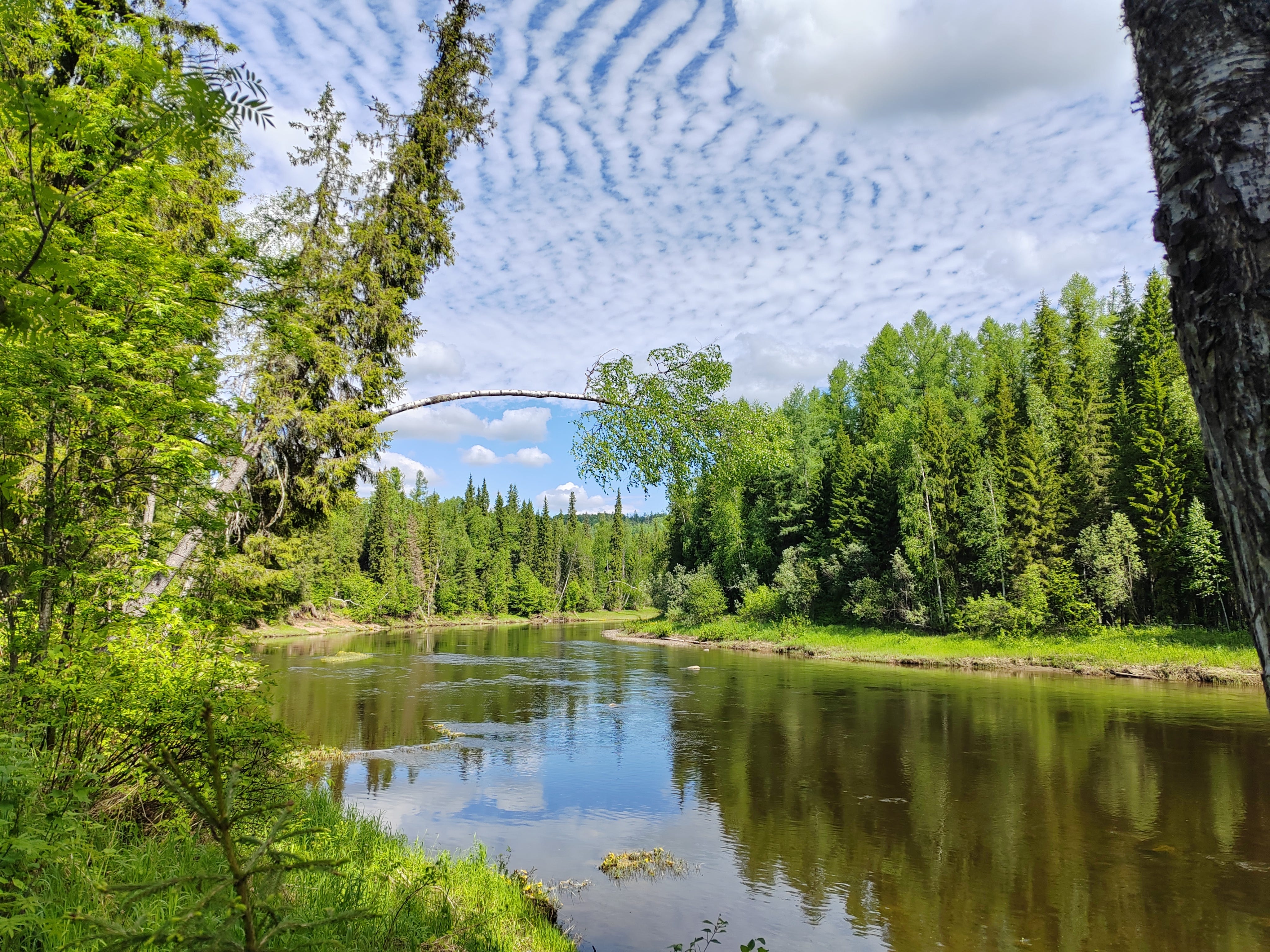
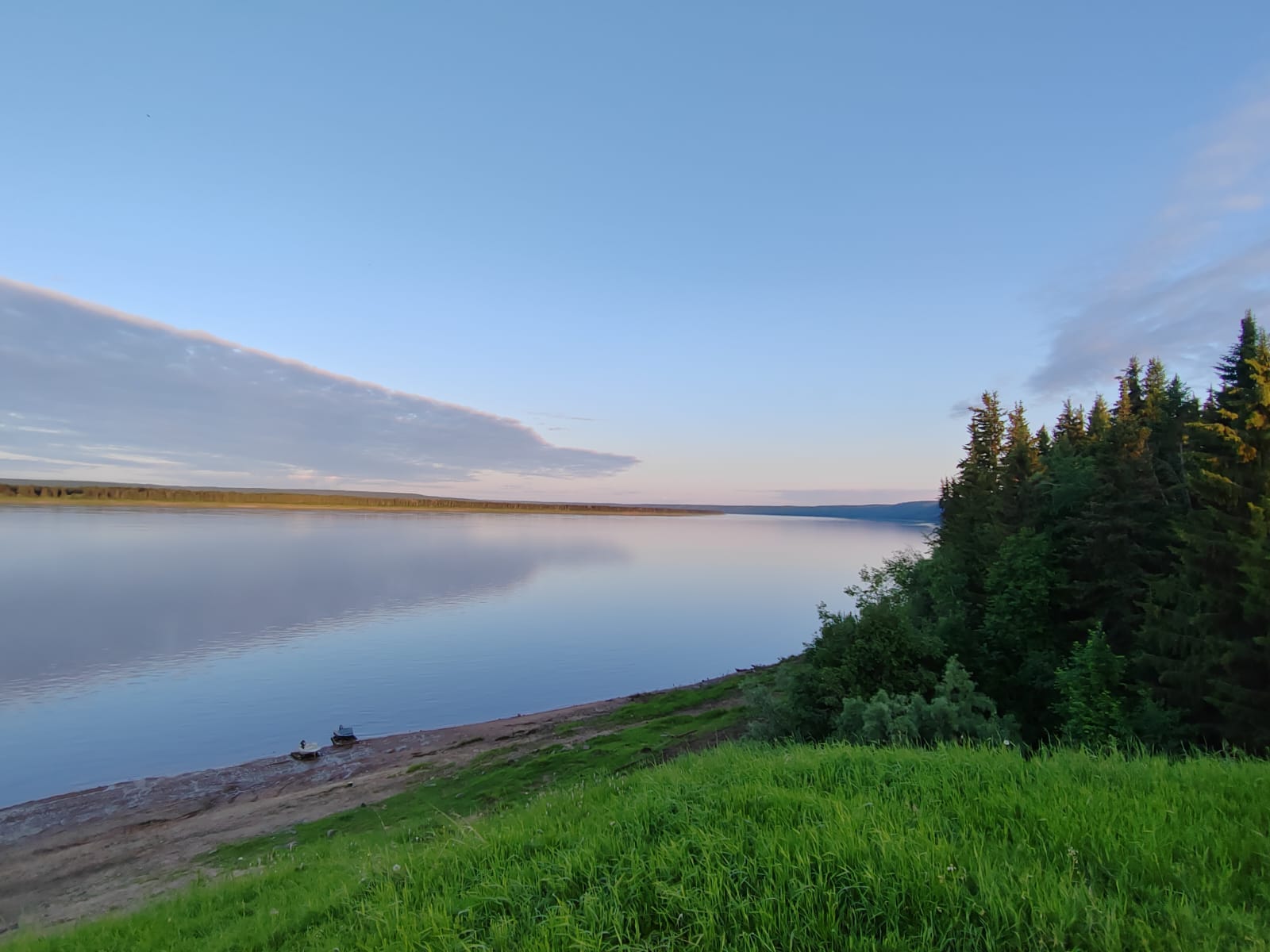
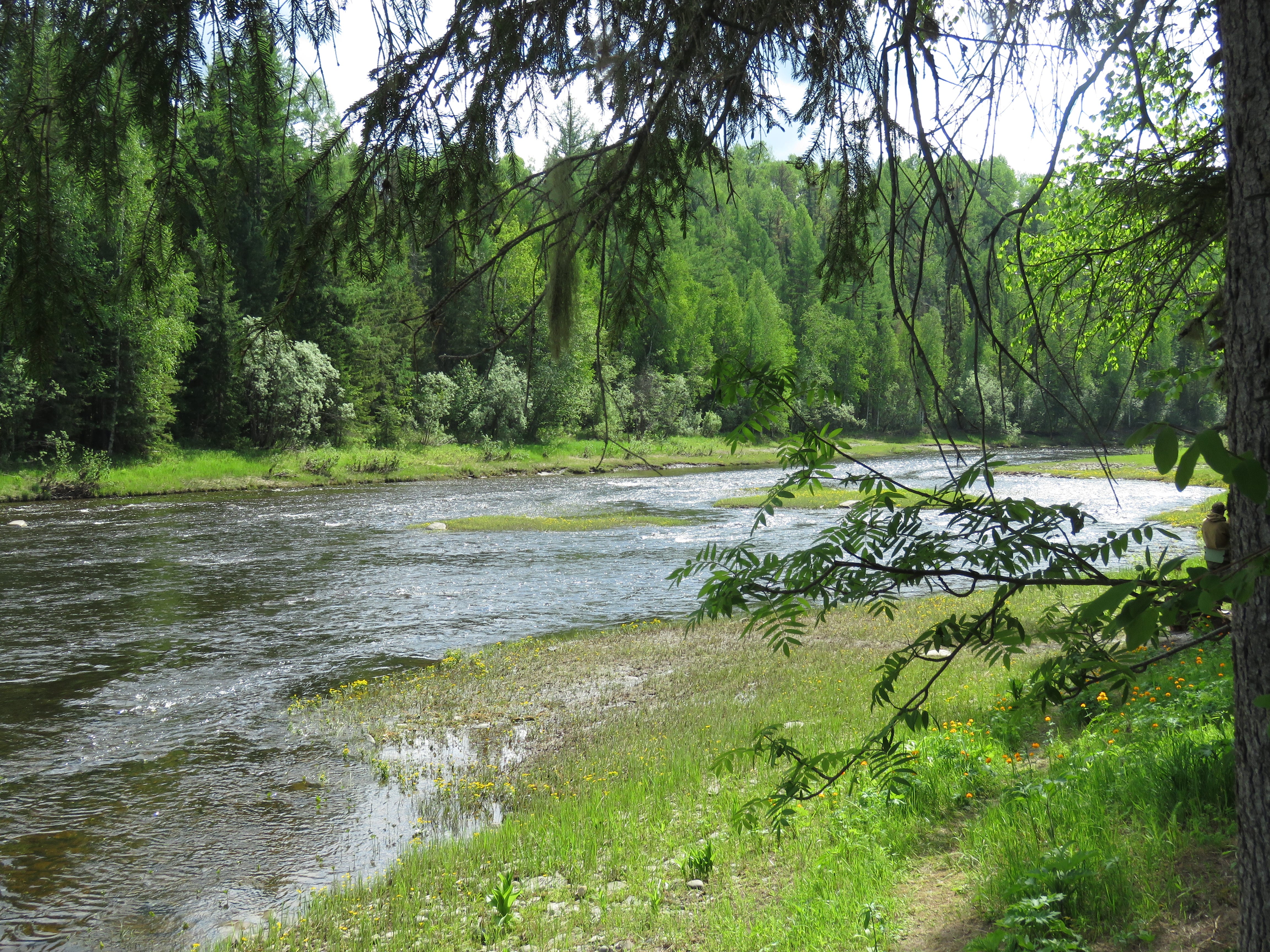
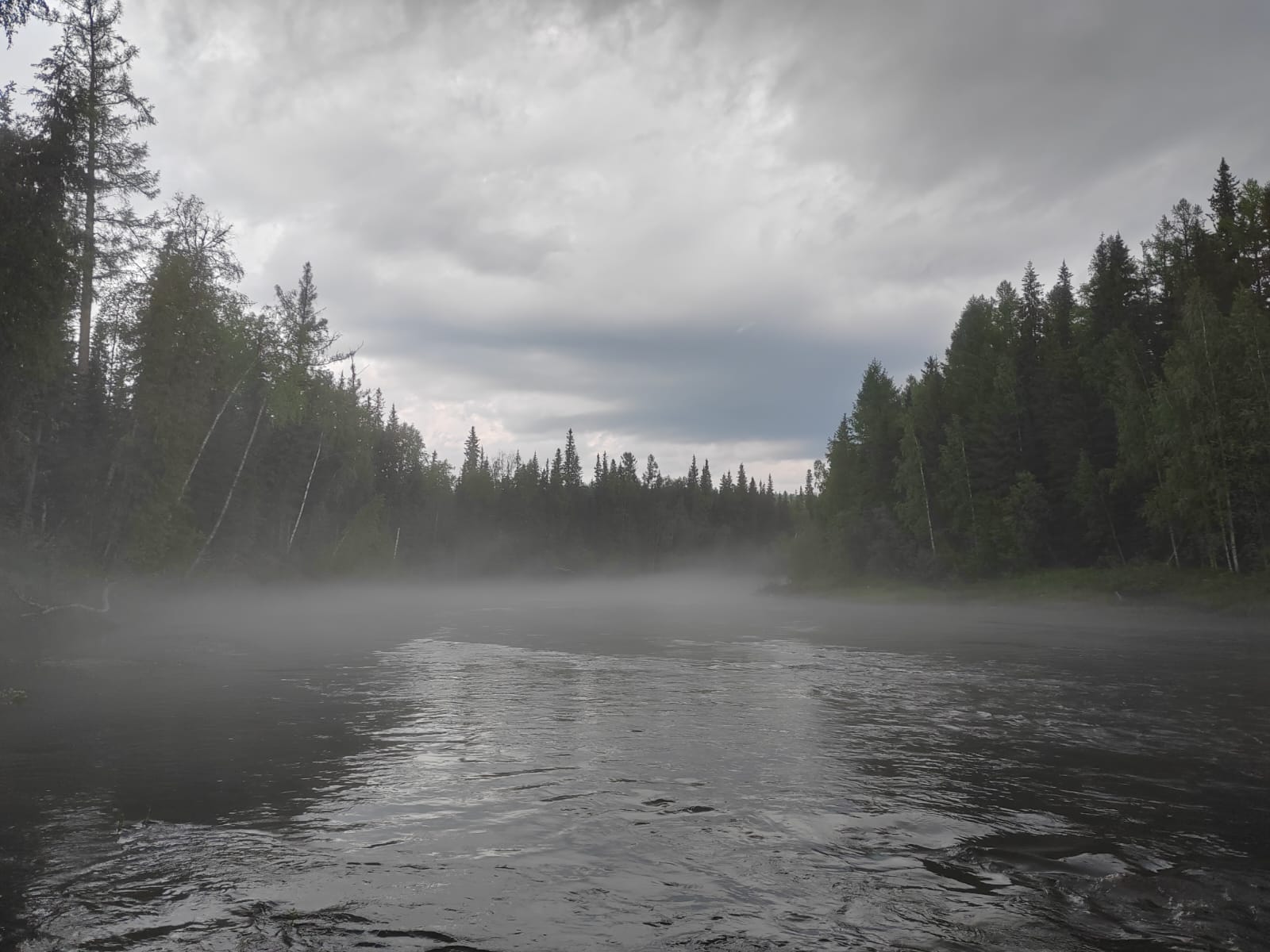
The text below has been edited for readability. This is my last scheduled post while I am away in the wilderness. As you read it, I am still offline, thinking that today my post should appear — if the civilization from which we have temporarily escaped is still functioning. So I have decorated our conversation with views of the Siberian wilderness in June.
Coming to forests from theoretical physics
Kathy: From MEER, Mirrors for Earth’s Energy Rebalancing. This is the MEER podcast.
Arjana: We explore climate science, systems thinking, and real-world solutions. Today we are talking about forests not just as carbon sinks, but as engines of planetary circulation.
Kathy: Our guest today is Dr. Anastassia Makarieva, a theoretical physicist from the Petersburg Nuclear Physics Institute in Russia.
Arjana: She is known for her work on the biotic pump theory: the idea that forests do not just respond to climate, they actively influence atmospheric circulation and rainfall patterns across continents.
Kathy: Anastassia, welcome.
Anastassia: Thank you, Kathy. Thank you, Arjana. It is my pleasure to be here.
Arjana: We’ll first get into your personal journey and origins. You are a theoretical physicist by training. How did you end up studying forests and atmospheric physics?
Anastassia: I graduated from the Faculty of Physics and Mechanics of the Leningrad Polytechnic Institute, but my department was the Department of Biophysics. Thus, my training was quite broad. It was not exactly training in the life sciences, but it gave me some glimpses into them.
The most important influence was one of our professors, Victor Gorshkov. I later became his collaborator. He taught a unique course on human ecology and biosphere stability. Through his work and through this course, I became acquainted with systems thinking, which you’ve already mentioned, and with a broader view of sustainability, biosphere stability, and how natural ecosystems matter for the Earth’s climate and environment.
It was due to his mentorship that I gradually came to study these things. He also worked as a theoretical physicist at our institute, and I joined the same theoretical department. I am very proud to be part of it. It provides a unique atmosphere of free research. This does not mean that we are very well financed, but research freedom is deeply respected.
Arjana: So you were not coming from traditional meteorology. You were beginning from physical principles.
Anastassia: Yes. I think this is one reason why we could develop something truly original. That it is original is not disputed: not everybody agrees with it, but nobody disputes its originality. It was a different perspective on these problems.
Arjana: Exactly, it’s so great when scientists from different backgrounds come and look at the climate problem from different perspectives. It is very helpful.
Kathy: Exactly, and I would say that, in a similar way, Dr. Ye Tao, the founder of MEER, also began with a chemistry and physics background before turning to the climate change challenge. This gave him a unique approach: tackling the three-dimensional problem of a heating atmosphere with a two-dimensional strategy of surface reflection.
Anastassia: This is a very large topic, because there are also social laws that govern science as a social enterprise. There are social forces that tend to push scientific communities toward groupthink. For example, when people vote to choose a new colleague, if there is even a small tendency to accept someone who thinks similarly, the system can spontaneously evolve toward more uniform thinking. This does not require bad intent or conspiracy; it is simply how social systems may work. That is one reason why disruptions so often come into a discipline from outside.
What a wild forest teaches
Kathy: Moving back to your area of focus, we have read that you spent summers in the northern Russian forest. How did those experiences shape your thinking?
Anastassia: This was a very important part of my education — education in the deep meaning of that word. What I now understand as the principal property of natural ecosystems is their fantastic complexity.
We do not have anything comparable in our urban life. We wake up and see a table, a chair, familiar human-made objects. But in a natural forest there are flows of energy and matter, and innumerable living creatures participating in them, genetically programmed and shaped by millions of years of evolution. They are doing very different things. Some are synthesizing organic matter, while others are decomposing it at the same time. Yet this does not produce havoc or chaos. It works smoothly and maintains natural beauty.
For me, studying natural ecosystems only became possible because I had seen this and had been immersed in this ecological action. One cannot really understand such a system in full; but one can, in a modest way, participate in it, belong to it, observe it from within. It formed in me a sense of complexity, and a sense of awe and modesty with which one should approach the analytical study of nature.
This is crucial, because one understands that a natural ecosystem cannot be described by one or two, or even one hundred, numbers. One has to think first of all about function: what these systems are doing and how they are organized in a highly complex, information-rich way.
And it is not enough to go to a neighboring park and see “nature” that is under human control. One needs to encounter a place developing by itself, through primordial forces. Then one sees the interplay of abiotic and biotic phenomena. For me personally, this was very important.
Kathy: That is a beautiful connection between observation and theory that you bring together in your work. I do share your passion and love for those natural forests, and the awe that one feels when one is in a remote forest.
Anastassia: Yes. It is a very unusual feeling of belonging and immersion. It gives one an impetus to go further: to try to understand, and to bring our own human enterprise into balance with this magnificent thing that is nature.
What is the biotic pump?
Arjana: Let us turn to the biotic pump. For listeners who have not encountered it before, what is the biotic pump theory?
Anastassia: The biotic pump theory is about how forests draw moisture inland.
There is an interesting story behind it. We had a colleague in the Amazon, Dr. Antonio Nobre, who knew about our other work on how natural systems regulate climate and the environment. We had been doing research related to carbon dioxide and climate stability. He said, in effect: look at the Amazon — we have this majestic water cycle and this majestic forest. It cannot be that they are unrelated. If you are studying biotic regulation, please come and explain what is going on here.
So from the very beginning it was a challenge from a friend. We began by asking: how can a forest do this? Life emerged from the ocean; at some point it had to march inland from the coast. How did it bring rain with it?
Today we can observe that, in the great forested regions, precipitation does not decline from the coast toward the continental interior in the way one would expect over non-forested regions. If air goes inland, rains out, and this water drains back to the ocean as rivers, then rainfall should diminish inland. But in the large forests this is not what we see.
So we thought: is there a physical mechanism by which forests could arrange to have enough rain to compensate for river runoff? This question arises because land differs fundamentally from ocean in that land is continuously losing water: it is elevated above the ocean, and due to gravity water returns to the ocean as runoff, and does so very rapidly. Therefore, to remain wet, land must receive an atmospheric inflow of moisture. There is no other possibility. The question is: how is this inflow maintained?
What we proposed is that, when water vapor condenses and falls out as rain, there is less gaseous matter in the atmosphere and pressure drops. It is as simple as that. For some reason, this effect had not received sufficient attention. We quantified it theoretically and showed that it is powerful enough to explain a potential forest impact on atmospheric circulation.
A forest transpires. During photosynthesis, a green leaf must open its small pores to take in carbon dioxide molecules. While these pores are open, many water vapor molecules leave the leaf. The atmosphere becomes moist. A moist atmosphere has fundamentally different dynamic properties from a dry one: different processes become possible.
When a forest keeps the atmosphere moist, the air can rise and cool; water vapor then condenses and precipitates. This condensation produces a pressure drop, and air moves toward that pressure drop from adjacent areas. If the adjacent area is the ocean, and the forest borders the ocean, moist oceanic air flows toward the forest and further into the continental interior.
That is the main idea of how the biotic pump functions.
Arjana: That is fascinating. So, as a brief summary for our audience: trees transpire vast amounts of water vapor; this vapor condenses; pressure drops; and moist air is pulled inland. So, rather than heat being the only driver of wind, your argument is that condensation itself can generate a pressure drop and draw moist air inland. Is that correct?
Anastassia: It is not that heat has no role. It does. What was new in the biotic pump theory was demonstrating that the pressure-drop mechanism associated with condensation and precipitation is significant.
Previously, this had not been shown, and because of that it was, and still is, assumed that forests cannot influence atmospheric dynamics in this way.
The mainstream view emphasizes differential heating: different amounts of solar energy arrive at different places, and this drives atmospheric currents in various ways. In that framework, forests can change this or that, but they do not crucially alter atmospheric dynamics, because their heating effects are considered relatively small.
Once we focus on the pressure drop related to condensation and precipitation, however, a new physical argument appears: forests can be crucial for atmospheric dynamics because they maintain the moist conditions in which this mechanism operates.
Deforestation and the possibility of abrupt change
Arjana: If this theory is correct, what does it change about how we should think about deforestation?
Anastassia: The biotic pump is part of a larger framework showing how forests matter for climate stability. First of all, if we destroy forests, we significantly undermine the stability of the terrestrial water cycle. This is a tragic prospect at a time when more and more people experience water shortage.
We believe that there has already been a major event in human history: a major desertification event caused by the destruction of the biotic pump. It occurred in Australia, which used to be green.
Australia was not, of course, a rainforest continent like equatorial Amazonia. Its geographical position is different: much of it is situated in a region where dry air tends to descend. Nevertheless, several tens of thousands of years ago Australia was much greener. For example, species of tree kangaroos that today occur only in moist tropical forests closer to the equator have left remains over much larger regions of the continent. Scientists now find their remains throughout Australia.
But when the first people came to the continent, approximately 40,000 years ago, there was, at approximately the same time, an abrupt shift to arid conditions. It was not caused by any large-scale climatic perturbation that would have been registered. Thus, it remained practically unexplained.
From the biotic pump viewpoint, if these people used fire for hunting, as we know they did, and if they burned forests along the coast where they originally settled, this could have cut the remaining tree cover — that is, the remaining biotic pump of the inner continent — off from oceanic moisture. Aridity could then have followed almost instantaneously on a geophysical time scale.
This proposed mechanism is less plausible directly at the equator, where rainfall is strongly favored by geophysical conditions and the presence of warm ocean. But where the background geophysical conditions are less favorable, such a flip may occur if vegetation is destroyed. We do not know exactly where this boundary lies or what level of disturbance may cross the threshold.
An ecosystem does not necessarily degrade linearly. As a regulatory system, when disturbed, it initially tries to compensate. One can therefore see the disturbance growing while, apparently, little changes. But internally, the resistance required to maintain homeostasis increases. The system struggles harder and harder, and then, at a certain point, it may break down.
This is especially relevant to the water cycle, because the water cycle involves many positive feedbacks that can proceed unchecked when biotic control is lost. Forests are makers of a dynamic equilibrium favorable to our existence. This is how we should view them. They are not just standing there. They are working. They are functional. When we destroy them, we destroy a function that keeps our planet habitable.
Arjana: That is very powerfully put. A previous guest from Brazil spoke about Indigenous rights and about seeing forests and trees as protectors. There is a resonance with what you are saying about forests as workers and protectors.
Anastassia: I think there is much true knowledge that people can gather when they live in direct contact with an ecosystem.
But it is also important that forests are not only relevant to the local water cycle: the Amazon forest is not important only for Brazil, nor the boreal forest only for Eurasia. Because these forests are so large, and because atmospheric circulation depends on them, they can have an important global impact.
This impact is not well understood or incorporated in global climate models. Climate models were developed primarily to describe how climate responds to increasing carbon dioxide, and they do a reasonable job with respect to that purpose: one does not find models predicting cooling from increased carbon dioxide; they robustly predict warming, although by differing magnitudes.
But when one looks at what models predict for deforestation in relation to the water cycle, there is no robust response and no clear constraint — no clear idea of what it should be. Some predict reduced streamflow, others increased streamflow, and the magnitude of the response varies greatly. Thus, they currently provide no guidance on the climatic importance of forests.
That is why we believe there is ample room for new insights and for a reconsideration of how we think about the importance of forests.
Are the Amazon and boreal forests vulnerable?
Arjana: How vulnerable are the Amazon and boreal forests now, in your view?
Anastassia: I can speak with more direct knowledge about boreal forests, although I believe the same central concern applies to the Amazon. My view is that intact forests, if not logged or burned, have a very high chance of withstanding the climatic changes now being imposed on them. For many forest species, a change of a few degrees is within the range of conditions they can naturally experience. There are, of course, ecosystems that are far more immediately vulnerable, such as coral reefs; I am speaking here specifically about forests.
The grave problem is what happens when we log a forest. We strongly disrupt the water cycle and the local moisture regime. We open the canopy. There is more wind, and therefore more uncontrolled evaporation rather than transpiration. Transpiration is a process controlled by the tree; evaporation from an opened, disturbed surface is not controlled in this way. When the canopy is opened, moisture can be rapidly lost. The forest dries, and once it is dry it becomes susceptible to bark beetles and other disturbances. Trees die; dead and weakened forests burn. A whole chain of disasters can begin with human interference.
Unfortunately, the idea of “sustainable forestry,” born roughly one or two hundred years ago, is based on neglect of the climate function of forests. Sustainability came to mean: we may cut as much timber as the forest regrows.
But think of a natural forest without humans. It does not “regrow” in this economic sense. Like the biosphere as a whole, it exists in a stable equilibrium. Every tree that dies gives life to an enormous number of creatures, all of which do something in the ecosystem. Consider, for example, the production of biological aerosols that participate in cloud formation — a process in which bacteria and fungi are involved.
In a natural forest, the annual increment used as a forestry measure is close to zero because the forest is not a crop; it is a stable living system. When we cut it, it begins to regrow, and then it has an annual increment. Sustainable forestry brings the forest to the condition where this increment is at its maximum, and keeps taking the maximum of what it produces.
It is as if we took a person and exploited him or her so as to obtain the largest possible output of work, leaving no free time, no relaxation, no resources for recovery. This is what we have been doing to the European forests for two or three centuries. Forest trees can live for two, three, or four centuries. Thus, for an entire forest lifespan, we have not given these forests a moment to breathe. We have continuously exploited them and called this sustainable.
What happens to a person exploited in this manner for an entire lifespan? Of course he or she breaks down. This is what is happening now with European forests: they are breaking down. Climate change is a trigger, but even without climate change, such overexploitation cannot continue indefinitely.
Now, when forests are in trouble under climate change, we should exploit them less, not more. They cannot simply give us pellets in order to become our “renewables.” If we continue in this way, we will lose them forever. What we should be doing is withdrawing from forests and allowing them at least one hundred years — which is very little in forest time — to have some time for themselves.
Kathy: That is a powerful metaphor and a sobering picture.
Anastassia: Yes. It is like saying: we provide this person with enough food, so the caloric value is adequate; why, then, did he or she become ill? Every complex system must have resources for its inner resilience. We are depriving forests of these resources.
In retrospect, I felt that here our conversation had gone slightly off track. We were discussing the need to give forests time for themselves — but in that very time they are working to keep the world habitable for us. But we do not properly recognize this work. — AM
How can the biotic pump be tested?
Arjana: What would it take to properly test the biotic pump hypothesis?
Anastassia: This is something we continuously think about. We cannot destroy an entire forest simply to see what happens. Fortunately, the Amazon forest is still resilient and still functional. Even if we see a decline in moisture inflow during the dry season, indicating that the system may already be close to the brink, this decline is still compensated during the wet season. We can see the forest attempting to rebalance.
Forests are extraordinarily complex. Therefore, we need indirect ways to show that the physical mechanism is correct: first to establish the physics, and then to apply that understanding to forests with greater confidence.
This is why we have studied tropical cyclones. Tropical cyclones are remarkable phenomena with intense condensation and precipitation in their centers. Unlike the Amazon forest, of which there is only one, tropical cyclones are numerous, so we have statistics. We can measure them and ask whether condensation of a given intensity produces pressure gradients of the magnitude predicted by our theory. This is what we have been doing, and we have found good agreement.
Another possibility is to study the general atmospheric circulation — the great circulation cells, such as the Hadley cells — and ask whether the observed global precipitation can drive the observed winds according to the proposed physics. This also gives good agreement. We proceed step by step, trying to show the scientific community that this is a valid proposition.
Kathy: You have also suggested that forests may influence cyclone formation. How might this work?
Anastassia: This remains to be studied in greater depth. The basic idea is that the fuel for tropical cyclones is atmospheric water vapor. Imagine a great forest drawing atmospheric moisture toward land. If there is a persistent outflow of moisture from the adjacent ocean toward the continent, tropical cyclones may have less water vapor available for their development.
This was one of the ideas that occurred to us in the early development of the concept [see Makarieva and Gorshkov 2010 and Makarieva and Gorshkov 2013]. If one looks at tropical cyclone tracks, one notices that the Atlantic Ocean between the Congo and Amazon forests is effectively free of tropical cyclones. There are no regular tropical cyclone tracks there. If one looks at how precipitation changes annually between the two forests, there is also a certain alternation: at some times the Congo forest receives more precipitation, at other times the Amazon receives more, but at all times little appears to be left for cyclone development.
[see also Sheil D. (2026) How Forests May Reduce the Incidence of Destructive Tropical Cyclones, Hurricanes and Typhoons. Forests, 17(3), 359; https://doi.org/10.3390/f17030359 — AM]
Of course, this is an a posteriori explanation. It is not yet a bulletproof demonstration. Other explanations are offered — for example, that there is simply insufficient space between the two continents for cyclone development. But at least one such event has occurred in the South Atlantic — Hurricane Catarina in March 2004 — indicating that tropical cyclone formation there is possible.
Arjana: Even as a hypothesis, it suggests a new way of thinking about forests: as possible stabilizers of global atmospheric systems.
Anastassia: Yes. And the argument extends further. Today there is intense discussion in climate science about possible catastrophic changes in ocean circulation: whether important oceanic flows may weaken or collapse, bringing drastic climatic changes. If atmospheric circulation depends substantially on forests, then disrupting a forest system as large as the Amazon could also have consequences for oceanic circulation. This is one further reason to recognize that these systems are interconnected.
Forests and the vertical transport of heat
Anastassia: There is another related aspect that we are studying: the role of forests in the vertical transfer of heat.
When forests transpire, energy that would otherwise heat the surface is used to evaporate water. When the vapor later condenses aloft, latent heat is released there. If the air remains aloft long enough, part of this energy may radiate to space from a higher level than it would if it were absorbed and converted to thermal radiation near the surface.
The important point is that this effect depends on circulation. If long-range circulation is replaced by small circulations in which air rapidly descends, the cooling effect may be weakened, as the air warmed by latent heat is brought back toward the surface.
If, however, the air remains aloft long enough for energy to radiate away, there will be a cooling effect. This is not an instantaneous process: the atmosphere can radiate only a finite amount of energy per unit time. The biotic pump represents a long-range circulation, with air travelling thousands of kilometres in the lower atmosphere and thousands of kilometres back aloft. Such circulation can keep air warmed by latent heat in the upper atmosphere for a long time. If we disrupt it and replace it with many small circulation patterns in which air descends quickly, this alone will warm the Earth.
This is a radical proposition, but it is one we have published and that can be examined. My view is that we need to open our minds to see how forests matter. They matter very greatly.
Criticism, inertia, and scientific change
Kathy: You have mentioned that your ideas are somewhat controversial in climate and atmospheric science. Scientific revolutions often do take time, especially when they challenge foundational assumptions. How do you avoid becoming discouraged by critics?
Anastassia: I think critics are a very good thing. I am not discouraged by criticism. In the first years I was a little surprised that developments did not proceed faster, but now, having more experience and having learned more about atmospheric science, I understand that science can move very slowly.
There is an example that has personally impressed me. More than a century ago, Margules posed the problem of how atmospheric potential energy can be converted into motion. Only decades later did Lorenz formulate available potential energy in the form that became central to modern atmospheric energetics.
The central problem is not necessarily criticism. Everybody in a scientific community is already doing their own work, and there is often little incentive to change direction. The life of a scientist is difficult: one needs grants, publications, and a place within a community. This is partly sociological, and partly the natural inertia of scientific development.
Criticism itself is positive because it means that one is being noticed. People do their best to show that one is wrong. Even if a critic goes away convinced that one is wrong, one is left with their arguments. One can consider them, see whether one is right, strengthen the argumentation, and emerge with a better understanding.
The main enemy is not criticism; it is non-existence — when a body of knowledge is treated as though it were not there. This undermines the essence of the scientific process.
For example, there are competing theories of tropical cyclone formation. We published a critique of a major theory in one of the central journals of meteorological literature, the Journal of the Atmospheric Sciences. The anonymous reviewers were surprised by its implications; yet, after publication, the broader community remained largely silent. It is often easier to speak against the mainstream when one does not belong to that community than from within it.
This is unfortunate. But science itself is so exciting that it keeps us going.
What keeps one working?
Arjana: After years of debate and persistence, what keeps you motivated?
Anastassia: I am motivated by two things.
First, I hope — and perhaps there are grounds for this hope — that society may reach a new stage of understanding itself, in which this knowledge can contribute to a new attitude and new ethics, if we survive the present predicament. Together with many other people, we are doing our small part to build that possible future, and to protect the beauty that is still here.
The second reason is more individual: the science itself is so exciting that I would not want to do anything else. Even when it is difficult to move forward, this is what keeps us going.
Arjana: It is exciting and also crucial. Doing this work can feel like helping to build the future.
Anastassia: Yes. Many of us share the feeling that this may be useful for the future — that, in some modest way, we may be contributing to building it. So many negative things are happening. We have little to rely upon except our intellect: we need to understand what is happening, and to change.
Kathy: Anastassia, thank you very much for putting your passion into action and for helping to illuminate the vital roles that forests play in the climate system. We wish you well in your continued research and advocacy, and hope to hear updates from you.
Anastassia: Thank you very much. Good luck with your important work as well.
Related reading:
Global cooling from plant transpiration

In recent decades, natural forests have continued to be decimated. Current climate models do not consider the post-deforestation reduction in transpiration as a significant climate change process. To get people think more seriously about what we are all losing, here we will attempt to advance the argument about a significant warming from reduced transpi…
In addition to the forested Biological Pumps of our planet, rivers in their original state, moving waters 24x7 are one of the major ecosystems that both provides biological pumping of nutrients to our oceans and land bound creatures, and are vast temperature regulators, mainly cooling, as they also provide habitat and safe drinking water. In addition volumes of fresh water from rivers have for eons of time provided a specific balance for maintaining ocean salinity and this balance is responsible for deep water currents that maintain a consistent climate suitable for life as we have known it.
Even as the author spends much of the time talking about Forests, clearly this is her first love, But it is not acceptable to continue overlooking river ecosystems and their intimate relationship with our oceans, forests, and atmosphere.
The major river systems of our planet, now dammed and fragmented by human greed can no longer be appreciated for their vast contributions as functional Earth ecosystems. Just as a patient confined to a hospital bed ,rivers value to our planet as key ecosystems are now on life support. Current extreme conditions around the planet are due in a LARGE part to an almost permanent serious injury to rivers.
Standing somewhat stagnant waters, even for months at a time, renders rivers impotent in their natural ability to regulate our life giving planet. Water slows or stops it looses key properties and gains in thermal heat, I could go on . Northern most rivers which our author knows much ,most sit stagnant for almost 6 months at a time and in the dead of winter rivers are forced to flow at volumes way beyond natural year-round flow rates. Maybe one day Anastassia will wake up to the problem right in her back yard...Siberia, here is where many rivers have been dead for nearly 60 years. And with the rivers dead, what does one think is happening to our Northern ocean...the Arctic region? where many of these dead rivers flow into mostly at asn unusual time of year, during winter, when the river is supposed to be asleep under Ice
Muy agradecido del tema y de la transcripción que es muy útil al momento de traducir.