
The Second Steam Power Revolution
From Burning Coal to Blowing Winds and Creating Clouds: How Forests Power Climate Stability

A passionate and intellectually illuminating perspective, offering unexpected insights into an emerging new ethic of respect for nature, by our great friend Dayana Andrade, a member of the Biotic Pump Greening Group. Featured is also some of Dayana and Felipe’s ecorestoration work. — AM
When, in the 18th century, we learned to use steam to produce motion, we called it the Industrial Revolution. And with good reason. James Watt’s improved steam engine ushered in an era of extraordinary technological innovation and sweeping social and economic change. The mass production of goods, the great rural exodus, and the rise of economic and political systems that still shape our world all trace their roots to that pivotal moment.
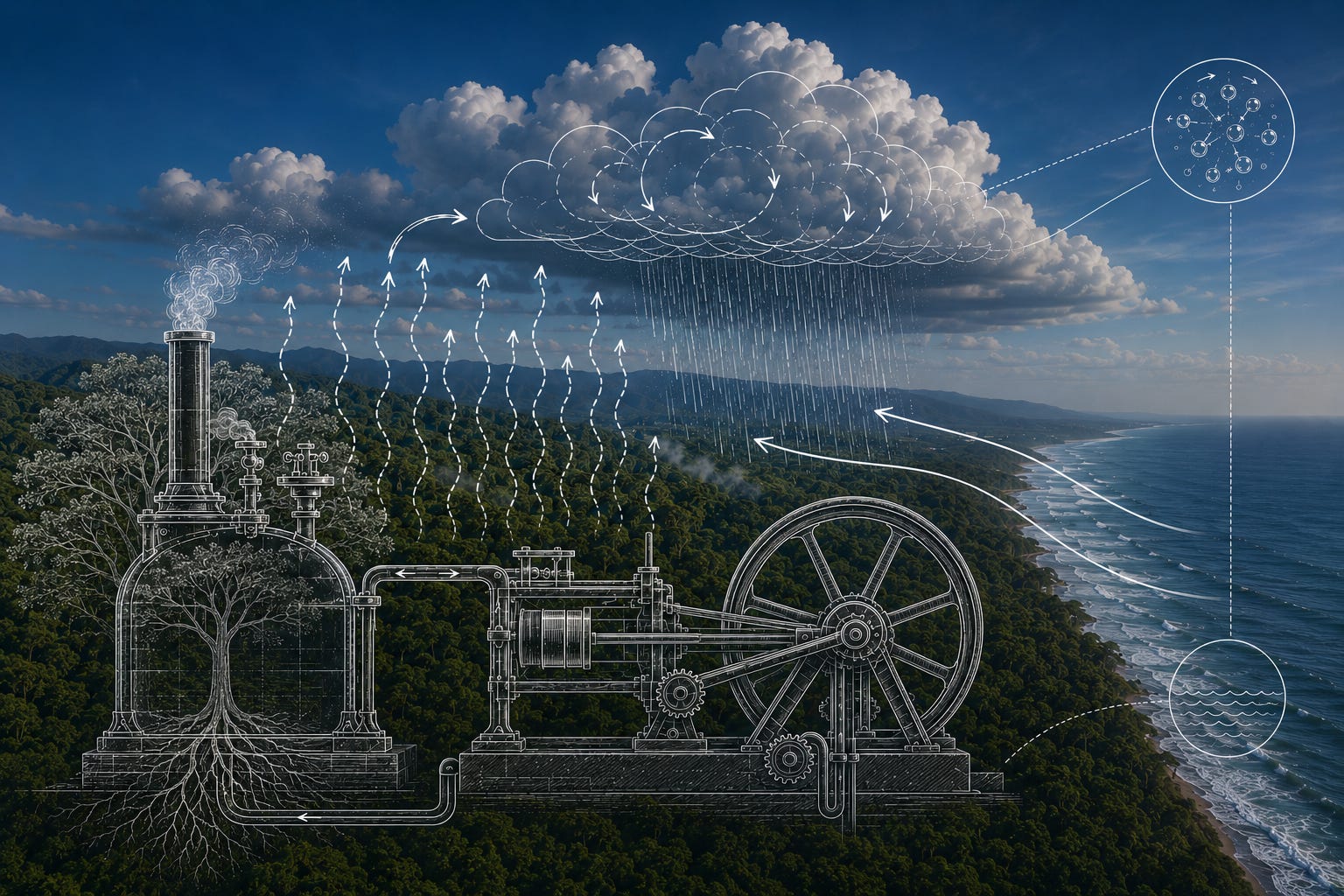
Little did we know that steam would one day stand at the center of another revolution. This time, however, it is not the steam that drives pistons, but the vapor that drives winds and weaves clouds. Not the steam that comes from burning coal, but the vapor lifted by forests, gracefully carrying heat from Earth’s surface upward, releasing it into space, delivering rain far inland, and maintaining the planetary conditions for life.
Unlike the first, the “Second Steam Power Revolution” relies on a mechanism that extracts nothing, generates no waste, and runs on sunlight rather than fire. If the first revolution led us to agglomerate in urban centers and fueled the illusion that we could conquer nature’s limits (a popular notion of its time), the second invites us to reconnect with nature and realign human systems with the living engines that sustain the biosphere, which in turn creates a hospitable planet. It calls us to recognize our role as conscious agents within the planetary water cycle, restoring rather than disrupting its elaborate flow. It is around the scientific exploration and dissemination of these principles and practices that the Biotic Pump Greening Group was formed.
Scientific Intuition and the Seeds of a New Climate Paradigm
In the mid-70s, in the Russian taiga, physicist Victor Gorshkov gazed at the Yenisei River and wondered, “If all this water flows to the sea, there must be a mechanism that brings an equivalent volume back to the continent.” In the early 2000s and thousands of kilometers west, Earth scientist Antonio Nobre looked out over the Amazon rainforest and asked, “How, despite known global cataclysms, did this magnificent biome sustain abundant rainfall over millions of years, without interruption? Is it just a passive hitchhiker of a favorable environment or a sitting duck for climate change?” Questions like these are the lifeblood of science. They arise from the suspicion that something essential is being overlooked, that there is still a principle to uncover, a pattern to explain.
When Antonio Nobre - a rainforest veteran and a longtime enthusiast of the Gaia hypothesis - first read the book Biotic Regulation of the Environment (2000) by Victor Gorshkov and Anastassia Makarieva, the intellectual connection was immediate. At the time, he was deeply immersed in ecoclimate data from the Large-Scale Biosphere-Atmosphere Experiment in Amazonia (LBA), which was propelling him toward a startling conjecture: natural forests might not merely submit to the whims of climate; they appeared to actively concoct the environment for their own comfort and benefit. This idea matched squarely with Gorshkov and Makarieva’s Biotic Regulation of the Environment Theory.
Their enlightened explanation of how ecosystems manipulate environmental flows struck him profoundly. For Nobre, it provided an elegant, first-principles foundation for the earlier insights of Gaia, much as Kepler and Newton had for the heliocentric model of Copernicus. Awed by the Russian theory, he reached out to the physicists in September 2004. Eager to test his conjectures, he challenged them to apply their grand theory to the Amazonian mystery: “prove physically how the rainforest keeps itself wet.”
This call to action from Amazonia sparked a new phase of their research. The ensuing collaboration - fusing Nobre’s empirical knowledge with the Russians’ theoretical prowess - led to Gorshkov and Makarieva’s reference work in 2007, which crystallized these ideas into the “Biotic Pump Theory.” Their productive and long-lasting partnership grew to include other key collaborators, such as the theoretical physicist Andrei Nefiodov, the hydro-meteorologist Adriana Cuartas, and the climate modeler Paulo Nobre, among others in several fields of knowledge. Ultimately, Antonio’s invitation wasn’t just about testing a theory; it was about sharing and articulating knowledge across disciplines and continents.
How Forests Move the Sky
The Biotic Pump Theory describes a physical and ecological mechanism by which forests attract moisture-laden air and secure their own water supply. Through photosynthesis and transpiration, forests release vast amounts of water vapor into the atmosphere. When this vapor condenses into clouds, it releases latent energy, causing a drop in local air pressure. As clouds turn into rain, this pressure difference acts like a pump, propagating downward and laterally, pulling moist air from the oceans toward the interior of continents. Forests also emit a variety of organic gases and particulates, such as terpenes, isoprenes, pollen, spores and others that act as cloud condensation seeds, helping raindrops form and enhancing precipitation. These mechanisms drive winds, deliver rainfall far inland, and help regulate global temperature by carrying heat upward, where it can dissipate into space. It also explains why declining tree cover threatens water security for hundreds of millions of people worldwide. In short, the Biotic Pump Theory shows that forests are dynamic engines of the hydrological cycle and key stabilizers of the planet’s climate, not just passive carbon sinks.
A Climate Theory Under Pressure
New ideas in science rarely gain acceptance overnight, and that’s precisely what protects their credibility. Every hypothesis must endure rigorous scrutiny, exposure to contradictions, and countless rounds of questioning. This is the nature of scientific progress, and the proponents of the Biotic Pump have embraced it fully, prepared to engage with critique and debate the theory in every arena.
The journey, however, was anything but easy. Their landmark article, Where Do Winds Come From?, faced a grueling public review process that lasted two and a half years before finally being published. Such resistance is not unusual for disruptive ideas, but in this case there was an aggravating factor. The principle at the heart of the Biotic Pump Theory unleashed a veritable earthquake in mainstream meteorology by demonstrating a long-overlooked physical factor: water vapor condensation as the main driving force in tropospheric circulation. In 2010, during its open peer-review phase in Atmospheric Chemistry and Physics Discussions, the paper ignited an unprecedented debate that spilled beyond the journal into various digital platforms, gathering more than 1,500 comments in a single online thread. Nearly all were addressed by Anastassia Makarieva, whose ability to turn intellectual challenge into energy is remarkable. This episode later became the subject of a sociological study on how digital platforms are transforming scientific communication by expanding the reach of ideas, accelerating feedback, and fostering more transparent and interactive exchanges. It highlighted the power of open peer review and online forums to serve as a new kind of scientific agora: a public square where complex and novel concepts can be debated in full view of the global community.
However, at first, the openness of the platform alone was not enough to prompt meaningful engagement from defenders of conventional climate models. It took repeated public invitations to revisit the arguments and analyze them rigorously. The persistence of the Biotic Pump authors - thoroughly documented in the open-review record - made it clear that the conversation would not simply fade away. Their insistence on dialogue underscored a deeper tension in the field: a reluctance to confront a framework that questioned the foundations of established models.
At the heart of the controversy lies a fundamental point: in conventional climate models, the work performed by the atmospheric heat engine is formulated via tuning parameters - something adjusted to observations but not derived from first principles. As a result, while these models register condensation and precipitation, they fail to capture the ability of these processes to physically influence atmospheric circulation and generate winds.
The Biotic Pump, by contrast, proposes that, if condensation is properly accounted for, it can not only refine our understanding of wind and rainfall but also explain the persistent gaps between projected and observed climate: from the abrupt onset of monsoons to the mechanisms that fuel the destructive power of cyclones, and even the extreme temperature peaks since 2023, which exceeded the most pessimistic projections.
This is no ordinary academic debate. It touches one of the most politically and economically sensitive areas of science today: the emphasis on the role of carbon-containing greenhouse gases, particularly CO2, as the primary driver of climate change. A perspective that adds forests and atmospheric vapor flows to the equation inevitably challenges the foundations of this “carbon-centric” narrative, along with the global markets, funding structures, and careers that have been built around it.
Initial efforts to sideline the Biotic Pump were unmistakable. But over time, that strategy failed. Today, dozens of peer-reviewed articles exploring the Biotic Pump have been published in respected scientific journals. Each new contribution has broadened the conversation, and the vigor of the exchanges that follow speaks to how consequential the debate has become.
Scientific breakthroughs often depend on moments when old assumptions give way to new ways of thinking. These moments do not emerge in isolation. They require spaces for open dialogue, conceptual flexibility, and cross-disciplinary thinking. And because these shifts ripple far beyond academia, engaging with broader society is just as important as internal consensus.
To support this transition, we may need to develop new languages. Ones that can describe the intricate relationships between forests, water, atmosphere, and life. What’s certain is that we need to share: share ideas, share evidence, share lived experiences. Because interconnection is not just a property of ecosystems. It’s also the foundation of how knowledge evolves, whether you’re looking up to the atmosphere or kneeling close to the soil with your hands in it.
Restoring Climate from the Soil Up
In 2015, a new thread was woven into the fabric of the Biotic Pump Greening Group. Once again, it was Antonio Nobre who acted as the seamster, just as he had in 2004, when he invited Victor Gorshkov and Anastassia Makarieva to study the Amazon. This time, however, what caught his attention was not a theoretical model, but a practical approach to land management: Syntropic Farming - a regenerative agroforestry system developed by Swiss farmer and geneticist Ernst Götsch. This approach seeks not only to recreate the structure of forests but also their functional complexity.
Through ongoing exchanges with Felipe Pasini and Dayana Andrade, experienced practitioners and long-standing collaborators of Ernst Götsch, the group gained field insights and practical frameworks for translating Biotic Pump physics into land-based strategies. In 2019, Felipe and Dayana officially joined the group, anchoring a deeper alliance between cutting-edge ecological science and restoration practices.
This integration was critical because activating the Biotic Pump is not simply a matter of increasing green cover. Reforestation without ecological coherence - especially the widespread use of fast-growing monocultures - has often led to low survival rates, poor ecosystem function, and, in some cases, even greater disruption of local water cycles.
Syntropic systems, by contrast, are based on ecological principles of stratification (organization of species into functional layers) and natural succession (temporal progression of plant communities over time). This vertical complexity creates multiple microclimates and pressure differentials that enhance air circulation, while intentional temporal dynamics accelerate regeneration toward mature systems capable of properly activating the Biotic Pump.
Farming that integrates nature's complexity: this footage documents 3 years and 7 months of transformation in southern Italy. From depleted land to a stratified, successional syntropic agroforestry system. A deliberate act of recovery through agriculture, from the soil up.
This integrated perspective now informs the group’s projects in diverse and challenging environments, from arid landscapes in Saudi Arabia to climate-stressed vineyards in France. By combining climate diagnostics, landscape hydrology, and syntropic design, the group develops land-use strategies that restore ecological functions, whether through large-scale regreening or by adapting productive systems to enhance climate resilience.
While the Biotic Pump theory provides the scientific foundation for preserving intact forests, syntropic agriculture complements this imperative with a practical blueprint for restoring degraded lands through farming. By making reforestation productive, it eases the pressure to convert natural forests into farmland and reframes restoration not as a moral imposition or economic sacrifice, but as a regenerative strategy that is both viable and desirable.
The Intelligence That Builds Upward
Watch a forest emerge from abandoned farmland, and you witness something that defies our industrial logic entirely. Where, over time, our machines inevitably wear down, break apart, and return to rust, living systems grow more intricate, more capable, more fertile with each passing season. This is the profound difference between entropy and syntropy - between systems that disperse energy and those that organize it into ever-greater complexity.
Industrial steam engines exemplify entropy in action: fuel burns, heat disperses, metal fatigues, and each cycle brings wear. The second law of thermodynamics governs this realm with iron certainty - energy always flows from organized to disorganized states, from useful to wasteful forms.
But step into an old-growth forest, and you encounter a different, fascinating physics. Here, diffuse sunlight becomes living wood. Atmospheric chaos becomes orchestrated rainfall. Simple soil microbiomes become vast networks that communicate across miles of root systems. This is syntropy: a concept, first demonstrated by the Italian mathematician Luigi Fantappiè in1944 and later explored (as “negative entropy”) by scientists like Austrian-Irish theoretical physicist Erwin Schrödinger and by Hungarian physiologist Szent-Györgyi to describe how living systems sustain and increase their internal order.
The forest operates like a factory where the machinery doesn’t just maintain itself - it continuously redesigns itself to become more efficient, more resilient, more interconnected. A mature tropical forest can move more vaporous water across a continent than the Amazon River moves to the sea, yet it does so while simultaneously cooling the planet, generating its own rainfall, and supporting millions of species in elegant collaboration.
This is the result of self-organizing processes, where individual components dissolve their boundaries and function as interdependent parts of a larger, co-evolved system. Each tree is both itself and part of something more. Each root network is both autonomous and entangled. Forests are living engines, operating with the precision of Swiss clockwork, but with the accumulated wisdom of millions of years of evolution.
Our current crises - climate breakdown, social fragmentation, ecological collapse - are symptoms of trying to solve 21st-century problems with 19th-century thinking. We’re still operating like black-soot-spewing steam engines in a world that demands the green brilliance of forest intelligence.
Toward a Regenerative Culture
In 2024, the Biotic Pump Greening Group further advanced its vision by co-organizing the international conference Embracing Nature’s Complexity, held in Munich.
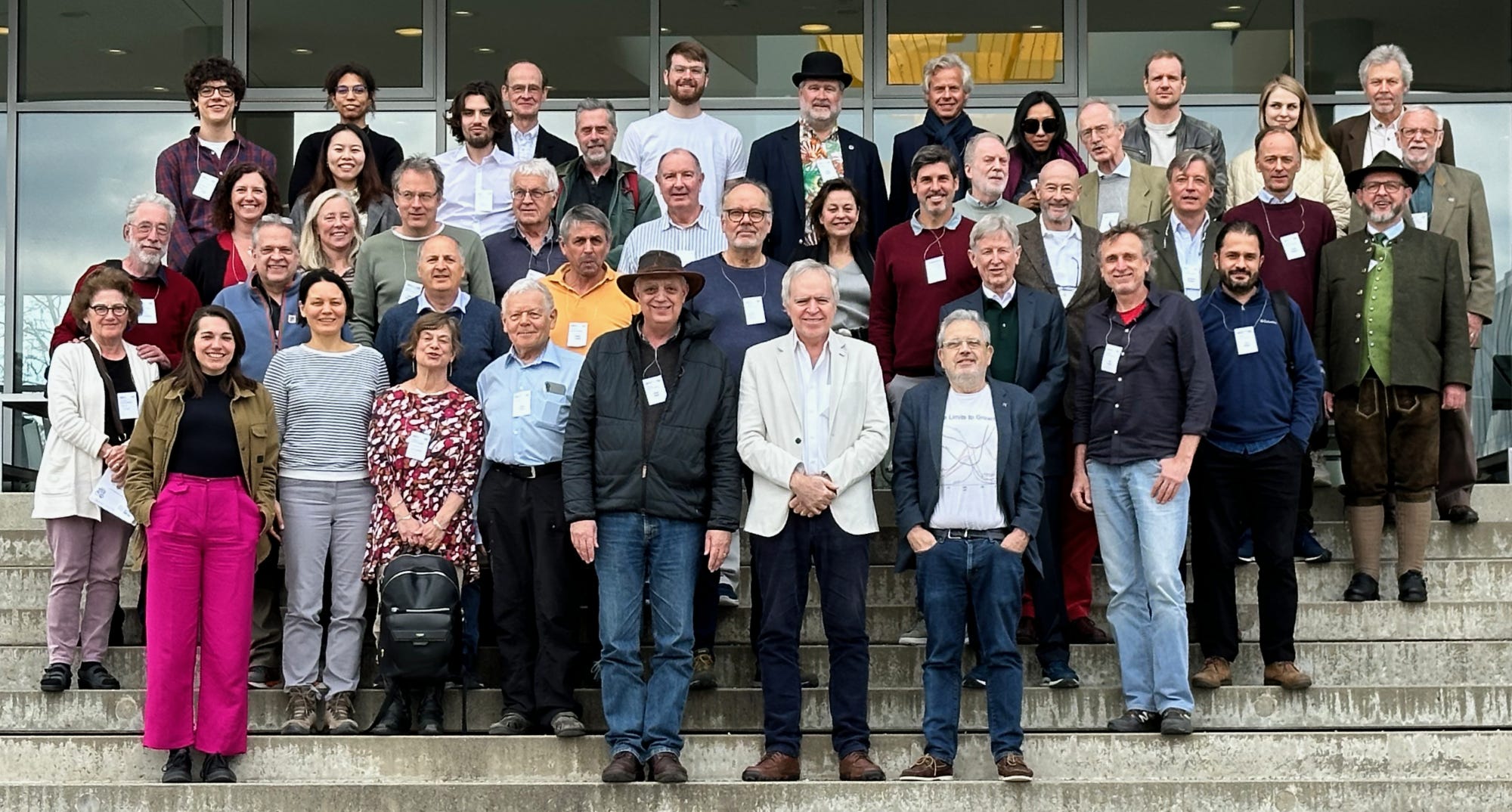
Far from a traditional academic event, it brought together scientists, farmers, policymakers, entrepreneurs, poets, communicators, and restoration practitioners from around the world. The goal: to elevate nature preservation with a strong scientific foundation, while bridging the disciplinary divides that have long hindered a full appreciation of ecosystems’ role in climate regulation and human well-being.
Currently, the group continues its work through an integrated and decentralized structure, spanning theoretical research, applied science across biomes, and support for large-scale ecological design and policy. Its members also contribute to intergovernmental programs, civil society initiatives, and educational institutions, promoting both eco-literacy and science-informed decision-making. Beyond scientific publications, the group embraces storytelling, art, and public communication as essential tools for translating data into shared meaning, helping to catalyze a cultural shift toward more conscious and collaborative ways of living on Earth. These diverse fronts operate across regions and disciplines, yet remain unified by a common aim: to protect and restore the living systems that make the planet habitable and to reweave the relationship between climate, culture, and care.
If mastering the steam engine required understanding pressure and combustion, engaging with the biotic steam engine demands something else entirely: ecological empathy. This shift redefines humanity’s role, not as external managers of nature nor even as benevolent stewards acting upon it, but as conscious participants in a planetary body, contributing our creativity and intelligence to life’s unfolding complexity.
This is the revolution already underway. And it begins, like all life does: growing by sharing.
Author’s Note: This article was first published in Ossigeno (No. 15, February 2026), a magazine produced by Fondazione Ossigeno ETS – NutsforLife. That issue’s theme was sharing (fitting, then, that this piece now finds a second life here).
Dayana Andrade is a journalist and syntropic farming practitioner. She is a member of the Biotic Pump Greening Group, where the connections between forest, water, and climate that Anastassia's work illuminates meet the hands-on practice of syntropic farming. With a Ph.D. in Environmental Sciences, she co-authored the book “Vida em Sintropia” with Felipe Pasini (available in PT, IT and FR). If this piece sparked your curiosity, follow their journey at “Life in Syntropy”.

Related reading:
 | A guest post by
|
Lovely, LOVELY article Dayana.
I'll limit myself to two points - for now.
Firstly, Is there anyone following Anastassia, Alpha Lo, Regenesis or even from the Biotic Pump Greening Group who will be attending the UN Water Conference in the UAE later this year? I only became aware of it because the World Farmer (ing?) Organization requested our Zambian National Farmers Union for comments on the WFO's submission to that UN Water Conference. I didn't comment so much on the submission (which addressed the issue of water regulation) but proposed that Humanity's only chance was to strengthen and enhance the Terrestrial Water Cycle - the Biotic Pump. (You mentioned both the need for complex forest (or at least tree cover) and the need to repair the soil. I believe you omitted the need to raise the water table, which will be the hardest sell. But, just as they have proven with fisheries, when we set aside 30% as a breeding reserve, we all catch more fish. So, if we raise the water table (by restricting our pumping of ground water) we will all have more water to use - through enhanced rainfall.)
Secondly, I think a mistake that is often made when environmentalists point to Nature as a role model, is that the Amazon, or the Serengeti are not actually productive in the sense that us humans (with 4 billion of us living in towns and cities) require. More or less everything that lives in the Amazon, dies in the Amazon (ditto the Serengeti). Syntropic farming is great for feeding small local communities, but I believe it needs modification in order to make it productive (or extractive) enough to feed 4 billion people in cities - and rising. My own thoughts on a compromise can be found in Farming as a System, on the Farmers Handbook page of www.Radio4pasa.com
Bruce Danckwerts, CHOMA, Zambia
🎯🎯🎯 👍👍👍 ❣❣❣ 🤗🤗🤗 !!!