
Stealing Forest Clouds?
Our eLetter to Science, and why local cooling over Amazon clearings should not become a message that deforestation offsets warming

On May 20, we published an eLetter in Science in response to the paper by Tom Dror and Graham Feingold, Amazon forest loss: An all-sky biophysical top-of-atmosphere cooling feedback.
Their study adds an important radiative dimension to a phenomenon that has been discussed in the Amazon literature for some time: shallow clouds can occur more frequently over cleared land than over nearby forest. Using satellite observations for 2003–2022, Dror and Feingold demonstrate that this enhancement of low-level cloudiness over deforested areas substantially strengthens the local top-of-atmosphere cooling signal relative to nearby stable forest.
This is a valuable result. But it demands especially careful interpretation.
The reason for our concern can already be seen in the accompanying commentary by Gunnar Myhre, published in the same issue of Science. Its title is Clouds moderate Amazon deforestation’s climate effect. Its subtitle reads: “An unexpected increase in cloud cover partially reduces warming caused by carbon dioxide release.” The commentary ultimately affirms the importance of maintaining and restoring Amazon forest cover. Yet an important qualification in Dror and Feingold’s paper is absent from it: they note that low-level cloudiness declined across the Amazon basin on average. As discussed below, even this mean decline does not reveal the regional structure of cloud loss.
Thus, a result derived from comparing deforested pixels with nearby stable forest has already entered discussion as an effect that partially reduces the warming caused by deforestation.
Here the issue of scale becomes critical.
A cleared patch can indeed be cloudier than the forest immediately beside it. From space, it may look locally cooler because it reflects more sunlight. But that does not mean that ongoing deforestation is making the Amazon as a whole cloudier, cooler, wetter or more resilient.
The local signal may arise because a clearing, embedded within a still substantially forested landscape, redistributes convection and clouds at the expense of neighbouring forest. Meanwhile, the more heavily disturbed regional sector may be drying, losing low-level clouds and becoming less able to sustain rainfall.
In short, the issue is not whether the local cooling signal is real. The issue is that it risks being interpreted as a climatic benefit of forest loss — without first asking the essential questions:
Relative to what — and at what scale?
Our eLetter, also available as an ESS Open Archive preprint, addresses this distinction. Below, I reproduce it in full. Afterwards, I provide additional context: how earlier research on local cloud patterns had already raised the question of spatial scale; what independent evidence suggests about the larger regional trajectory; and why the climatic function of an intact forest cannot be assessed clearing by clearing.
Our eLetter to Science
Stealing Forest Clouds?
Anastassia M. Makarieva, Andrei V. Nefiodov, Antonio Donato Nobre, Luz Adriana Cuartas, Mara Baudena, Germán Poveda, Juan Fernando Salazar
Affiliations:
Biotic Pump Greening Group Institute, São José dos Campos, Brazil;
Theoretical Physics Division, Petersburg Nuclear Physics Institute of NRC “Kurchatov Institute,” Gatchina, Russia;
National Center for Monitoring and Early Warning of Natural Disasters (CEMADEN), São José dos Campos, São Paulo, Brazil;
Institute of Atmospheric Sciences and Climate, National Research Council, Turin, Italy;
Department of Geosciences and Environment, Universidad Nacional de Colombia, Medellín, Colombia;
Escuela Ambiental, Facultad de Ingeniería, Universidad de Antioquia, Medellín, Colombia.
Dror and Feingold use 2003–2022 satellite observations to estimate the local radiative response to Amazon forest loss (1). They report that deforested pixels have more low-level clouds and lower cloud tops than nearby stable forests, increasing reflected shortwave radiation and yielding a local all-sky biophysical cooling signal. This result is important, but its interpretation depends on scale.
Their comparison is between cleared pixels and forests within 10–50 km. This is the scale at which deforestation can redistribute convection, clouds, and rainfall rather than generate a net increase.
Forest–nonforest transitions affect rainfall locally (2). Forest loss can increase rainfall at 20–80 km but decrease at about 200 km (3), while another analysis found wet-season enhancement locally but reductions beyond about 60 km (4). Clearing creates gradients in temperature that can favor clouds over open land while suppressing them over adjacent forest through a breeze-like circulation (5).
In this sense, deforested areas may be “stealing” forest clouds: reorganizing cloudiness within a drying atmospheric system rather than creating additional clouds. This is consistent with Dror et al. (6), who show that shallow green cumulus in the Amazon is associated with positive relative-humidity anomalies. This would suggest reduced cloud formation under basin-wide drying. Dror and Feingold note a basin-wide decline in low-level cloudiness that was less pronounced over cleared land at their comparison scale (1). At larger scales, however, the relative pattern appears to reverse: many deforestation hotspots are located in regions of declining low-cloud cover (Fig. 1), consistent with the observed dipole of increased solar-radiation absorption over the more deforested southeastern Amazon and decreased absorption over the least deforested northwestern Amazon (10).
The importance of scale becomes even greater when these findings are projected to increasing deforestation. Understanding deforestation’s climate impact requires assessing local radiative effects together with atmospheric dynamics.
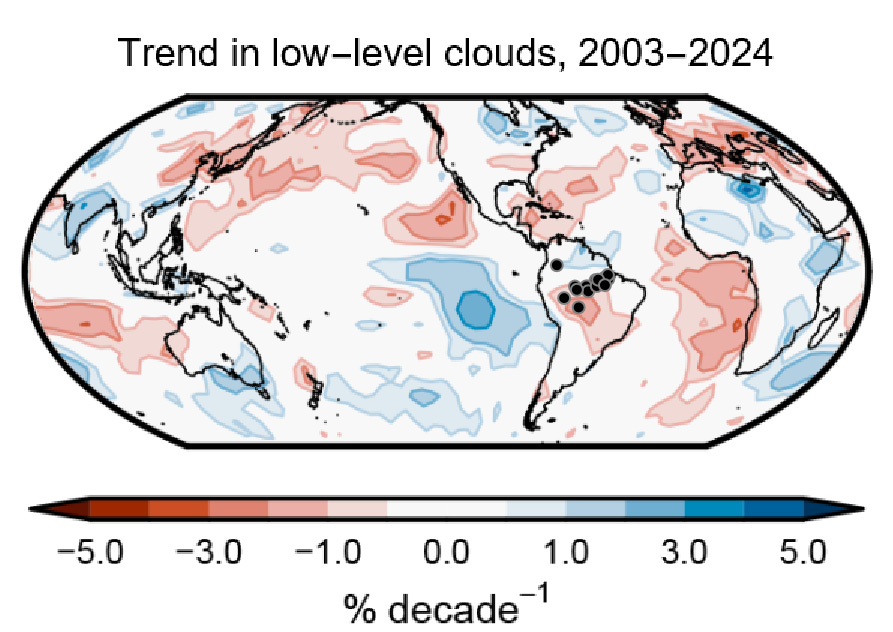
Figure 1. Low-level cloud trends from Ceppi et al. (2026), with Amazon deforestation hotspots from Mataveli et al. (2022) and Finer et al. (2025) shown as black dots.
References and Notes
T. Dror, G. Feingold, Amazon forest loss: An all-sky biophysical top-of-atmosphere cooling feedback. Science 392, 429–432 (2026).
R. Knox, G. Bisht, J. Wang, R. Bras, Precipitation variability over the forest-to-nonforest transition in southwestern Amazonia. Journal of Climate 24, 2368–2377 (2011).
A. T. Leite-Filho, B. S. Soares-Filho, J. L. Davis, G. M. Abrahão, J. Börner, Deforestation reduces rainfall and agricultural revenues in the Brazilian Amazon. Nature Communications 12, 2591 (2021).
Y. Qin, D. Wang, A. D. Ziegler, B. Fu, Z. Zeng, Impact of Amazonian deforestation on precipitation reverses between seasons. Nature 639, 102–108 (2025).
J. Wang, F. J. F. Chagnon, E. R. Williams, A. K. Betts, N. O. Renno, L. A. T. Machado, G. Bisht, R. Knox, R. L. Bras, Impact of deforestation in the Amazon basin on cloud climatology. Proceedings of the National Academy of Sciences 106, 3670–3674 (2009).
T. Dror, V. Silverman, O. Altaratz, M. D. Chekroun, I. Koren, Uncovering the large-scale meteorology that drives continental, shallow, green cumulus through supervised classification. Geophysical Research Letters 49, e2021GL096684 (2022).
P. Ceppi, S. Wilson Kemsley, H. Andersen, T. Andrews, R. J. Kramer, P. Nowack, C. J. Wall, M. D. Zelinka, Emerging low-cloud feedback and adjustment in global satellite observations. Atmospheric Chemistry and Physics 26, 4153–4171 (2026).
G. Mataveli, G. de Oliveira, M. E. D. Chaves, R. Dalagnol, F. H. Wagner, A. H. S. Ipia, C. H. L. Silva-Junior, L. E. O. C. Aragão, Science-based planning can support law enforcement actions to curb deforestation in the Brazilian Amazon. Conservation Letters 15, e12908 (2022).
M. Finer, A. Ariñez, N. Mamani, M. Cohen, A. Santana, Amazon Deforestation & Fire Hotspots 2024. Monitoring of the Andes Amazon Program 229 (2025).
J. Cui, S. Piao, C. Huntingford, T. Wang, D. V. Spracklen, Historical deforestation drives strong rainfall decline across the southern Amazon basin. Nature Communications 17, 1642 (2026).
Additional context
Earlier research on local cloud patterns and the question of scale
The tendency for shallow clouds to occur more frequently over cleared Amazon land than over adjacent forest has been examined in earlier research. In 2009, Jingfeng Wang and colleagues showed that shallow clouds preferentially occurred over deforested surfaces, whereas the less frequent deep clouds tended to favour forested surfaces. They related this local pattern to atmospheric circulations generated by contrasts between forest and clearing: where surfaces with different properties occur side by side, rising air and cloud formation can be redistributed across the landscape.
Importantly, Wang and colleagues also recognised that this local response raised a question about progressive deforestation. A clearing embedded within extensive forest is not physically equivalent to a landscape where forest loss has expanded over large areas. As the landscape becomes more uniform, the local contrast responsible for enhanced shallow cloud formation over clearings may weaken or disappear.
They wrote:
“There must be a limit to the length scale of land cover heterogeneity above which the lifting mechanism is lost and the enhancement of shallow clouds over deforested areas will disappear.”
A local radiative contrast between clearing and neighbouring forest cannot automatically be extrapolated to the climatic effect of continuing deforestation across the Amazon.
From a basin-wide mean to the regional pattern
Dror and Feingold note that low-level cloudiness has declined across the Amazon basin on average. Yet an average decline does not identify its spatial structure. It could reflect similar losses throughout the basin, or it could be dominated by losses in more heavily disturbed regions while less disturbed regions remain comparatively stable or show increasing cloudiness.
Figure 1 above points to the latter possibility. Many major deforestation hotspots are situated in regions of declining low-cloud cover, particularly in the more deforested southern and eastern Amazon. Toward the less disturbed northwest, low-cloud trends are markedly different.
This regional pattern does not contradict Dror and Feingold’s local comparison. At distances of tens of kilometres, a clearing may be cloudier than nearby stable forest. At the scale of broad Amazon regions, however, extensive forest loss occurs within landscapes showing declining low-cloud cover, while less disturbed regions show markedly different cloud trends.
This distinction is central to the phrase “stealing forest clouds.” A deforested patch may locally attract or retain more shallow cloud relative to its immediate forest neighbour, while, at broader regional scales, major deforestation hotspots occur within regions of diminished cloud cover and weakened cloud shielding.
The Amazon dipole: contrasting trends in cloud shielding
A complementary indication of this regional structure comes from the recent study by Jiangpeng Cui and colleagues, Historical deforestation drives strong rainfall decline across the southern Amazon basin. Their analysis shows greater sunlight reaching the surface in the more deforested southern and eastern Amazon, but decreasing surface sunlight in the less deforested northwest.
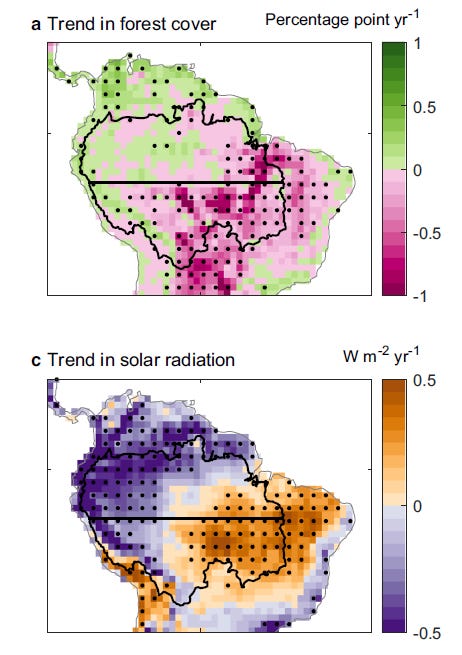
Forest loss and sunlight reaching the Amazon surface. In the more heavily deforested southern and eastern Amazon, forest cover declined while more downward shortwave radiation reached the surface. In the less deforested northwestern Amazon, downward surface shortwave radiation tended to decrease. Source: Cui et al. (2026), Nature Communications.
The variable shown here is incoming sunlight at the surface, not cloud cover directly. Nevertheless, the spatial contrast is consistent with weakening cloud shielding in the more deforested southern and eastern Amazon and increasing cloud shielding in the less deforested northwest.
Thus, a clearing may be locally cloudier than nearby forest, while the broader regional pattern associates greater forest disturbance with declining cloud protection.
What happens as deforestation progresses?
A clearing surrounded by extensive forest can generate a local atmospheric contrast. But what happens when clearings expand, the forest becomes fragmented, and the landscape becomes increasingly uniform?
There is a memorable illustration of this question from Australia. In 2002, Tom Lyons published a paper with the direct and beautiful title, Clouds prefer native vegetation. In southwest Western Australia, where large areas of native vegetation had been replaced by agriculture, clouds could be seen forming preferentially over native vegetation while cleared land remained largely cloud-free.
A friend recently sent me a photograph illustrating the same striking pattern.
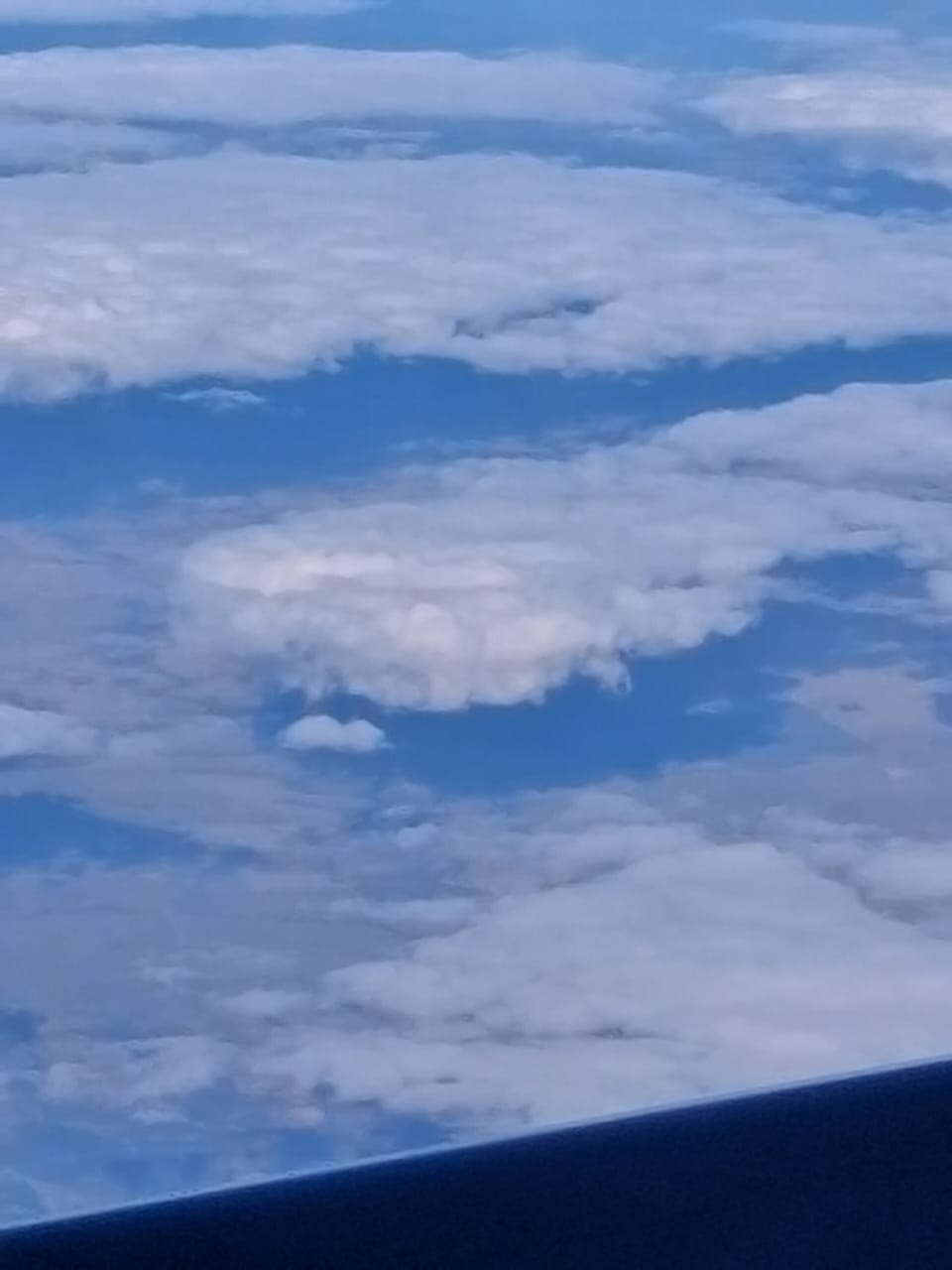
Clouds over vegetation beside cleared land in eastern Australia, May 2026. This contemporary photograph visually echoes the phenomenon discussed by Tom Lyons in Clouds prefer native vegetation. Image shared by a good friend and reproduced with permission.
This photograph helps us see why the response of one clearing embedded within forest cannot simply be extrapolated to a progressively deforested landscape.
Within a forest–clearing mosaic, open land may locally attract shallow clouds because it contrasts with the moist forest around it. But after more extensive removal of native vegetation, the landscape may lose the moisture supply and atmospheric organisation needed to sustain clouds more broadly.
A cloudier clearing can therefore be a feature of a still-heterogeneous landscape — one that remains dependent on the forest surrounding it.
Relative effects and actual trajectories
In my recent mini-series, China at an Ecohydrological Crossroads, I discussed a related interpretive problem.
In the China case, a reported decline in water availability associated with re-greening was not an observed regional decline. It was a reconstructed relative effect: an estimate of how vegetation change altered water availability compared with a hypothetical trajectory without that change. Meanwhile, the directly reported ERA5 trend showed slightly increasing water availability in China during the studied period.
The Amazon-cloud question is different in its processes and observations. Yet the same distinction matters here: a relative local effect should not be mistaken for the actual trajectory of the larger system.
A deforested Amazon patch may have more low clouds than nearby forest. This does not establish that progressive deforestation is making the Amazon cloudier.
A cleared patch may exhibit a local cooling signal relative to neighbouring forest. This does not establish that deforestation offsets warming.
The new Science paper shows that local cloud changes are an important part of the radiative response to forest loss. What this local signal means for a progressively deforested Amazon is a different question.
A clearing may brighten and become locally cloudier. But the clouds above it may, in part, depend on the forest system that its expansion would help to erode.
Let us work to stop deforestation in the Amazon. When asked by when this must be done, Antonio Nobre has a simple answer: “By yesterday.”
Related reading [another eLetter about Forests and Clouds]:
Thanks for this. Although it is surprising that anyone could propose that the effect on a small pixel of deforested land could be used to predict the behavior of the whole system should more land become deforested, "we" (on the side of trees) are guilty of making the same mistake! In a recent Nate Hagens interview, Brett KenCairn claimed that a regenerated woodland of just 5 square miles was enough to increase local rainfall. I am always wary of a figure like 5 square miles, as I worry that he might actually have meant 5 miles square, which is 25sq miles! But, more importantly for this discussion, I believe that if that patch of forest was indeed experiencing higher rainfall, it would almost certainly have been at the expense of the surrounding, non-regenerated country. 5sq miles (or even 5miles square) of regenerated woodland would not be sufficient to prime the Biotic Pump and draw more moisture in from the oceans. We have to appreciate that the Biotic Pump will work best with a more or less unbroken chain of woodland/forest from the coasts to the interiors.
Bruce Danckwerts, CHOMA, Zambia
I'm still a little unclear why a deforested region would generate more cloud cover, and where it would be getting the moisture if not stealing it from surrounding forest. Can anyone explain in a little more detail the mechanism by which clouds appear of clearcuts in the Amazon.