
Biotic Pump Q&A
Responding to readers: the role of oceanic moisture in watering land, why—if the biotic pump drives winds—they slow over forests, how forests can stabilize rainfall, and ecorestoration vs fires

One of the main motivations behind my scientific research is to contribute to an ethical and intellectual paradigm shift in humanity—one in which we reach a level of consciousness that prevents us from completely destroying what will remain of nature and allows it to begin self-recovering from the present-day massacre. A necessary prerequisite for this shift is making scientific results accessible to as many people as possible, and I am grateful for the opportunity to receive feedback from readers.
In this post, I address several recent comments to a LinkedIn post by Louis De Jaeger that described the biotic pump concept and generated considerable interest (1800+ reactions and 400+ reposts). Specifically, I will discuss the role of ocean-derived moisture, the observed reduction in wind speed over land compared to the ocean and what it means for the water cycle, and the mechanisms by which forests can contribute to the stabilization of local precipitation and runoff. Additionally, I will repost here my response originally published in comments about whether we can revegetate land to make it less fire-prone. At the end of the post, several publications are suggested for further reading.
What is the role of oceanic moisture in watering land?
Matthew Price-Gallagher on LinkedIn commented as follows:
While the biotic pump theory underscores the vital role of forests in generating low-pressure zones through transpiration to draw in moist air, it’s important to recognize this mechanism as a specific component of the broader hydrological cycle; the continuous global movement of water through evaporation, condensation, and precipitation. Data indicate that although forests contribute significantly on a regional scale [contribute to what? — AM], the oceans play a dominant role by providing the vast majority of atmospheric moisture through evaporation. In effect, the oceans drive large-scale circulation patterns that ultimately feed into the localized processes described by the biotic pump. This integrated perspective emphasizes how both marine and terrestrial ecosystems are essential, with the sheer scale of oceanic moisture output underlining its primary importance in sustaining precipitation even far inland.
To understand the roles of forests and oceans in sustaining the water cycle on land (see also “The tug-of-war between forests and oceans”), let’s take a look at this simplified scheme of ocean-to-land moisture transport. First, evaporation occurs over the ocean. Then, horizontal winds carry this moisture over the land. Once over land, the air rises and cools, causing the imported moisture to condense and fall as precipitation, which replenishes soil moisture and sustains life. Green plants transpire and photosynthesize food for the entire ecological community on land. The net imported water—precipitation minus evaporation and transpiration—returns to the ocean as runoff.
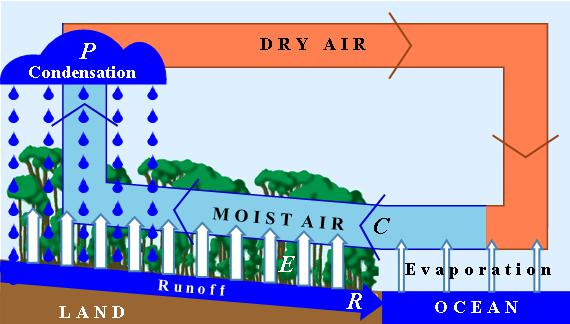
We can see, therefore, that two processes are required for moisture to be imported from the ocean to land: horizontal winds and vertical ascent. If the air does not rise over land, no matter how much moisture the horizontal winds carry, it will simply pass over without producing precipitation.
The biotic pump concept describes how forests regulate both components of this transport—horizontal and vertical air movement—to maintain a stable and sufficient inflow of moisture from the ocean.
The physical mechanism behind this regulation is the pressure drop caused by condensation. By moistening the atmosphere through transpiration, forests facilitate condensation over land, leading to the formation of a low-pressure zone that draws in moist oceanic air.
We can thus see that the import of oceanic moisture is absolutely crucial for terrestrial life to function. If this import stalls, soil will quickly lose moisture through runoff, and the ecosystem will dry out. Forests, through the biotic pump mechanism, regulate both the intensity and stability of this moisture inflow. In contrast, land stripped of natural vegetation becomes effectively locked out of oceanic moisture. No matter how much evaporates over the ocean, it will not travel inland.
To illustrate this post, I visited https://earth.nullschool.net and checked the weather for 2025-04-21 13:00 UTC in the Brazilian Amazon and Australia. The graphs below show the 3-hour precipitation accumulation (white and purple colors) at the time of writing.
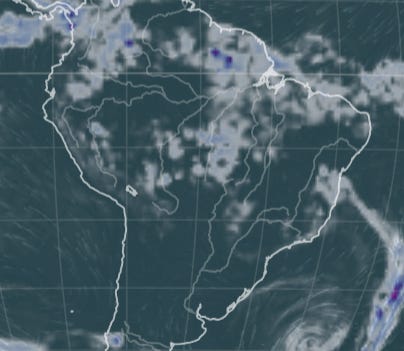
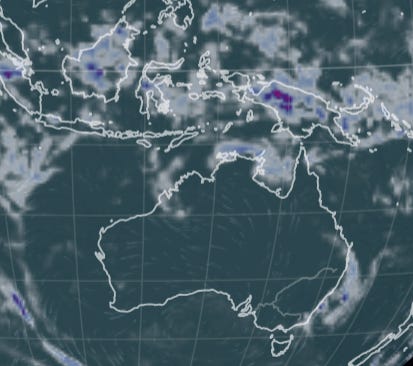
We can see that forested areas in both regions correspond to regional precipitation maxima, with rainfall exceeding that over the adjacent ocean. In contrast, in unforested regions—such as all of Australia and South America south of the 20th southern parallel—precipitation occurs over the ocean but is largely absent over land. These typical weather patterns translate into consistent long-term climatological patterns (as discussed in “The tug-of-war between forests and oceans”).
If the biotic pump drives winds, why are winds slower over forests than over the ocean?
Fritz Eder on LinkedIn commented as follows:
In fact forests REDUCE wind speed. Forests evaporate / km² MORE water than a ocean under same temperature condition. Bt the windspeed over sea is higher than over forest land.
We have discussed that, for moisture to be imported from ocean to land, the moist air over land must ascend and cool—leading to precipitation. The dry air then returns over the ocean, where it descends.
In other words, moisture import (as regulated by the biotic pump) depends not on horizontal wind speed alone, but on a specific combination of horizontal and vertical air movements.
Because air is conserved, upward motion (ascent) reduces surface airflow and wind speed, while increasing airflow and velocity at higher altitudes. Thus, the observed reduction in wind speed over forests compared to that over the ocean is a sign that the air is rising over land.
Once again, let us look at what happens in the Amazon. The graphs below show wind speeds at the surface (top panel) and at approximately 5 km altitude (bottom panel), with green indicating stronger winds.
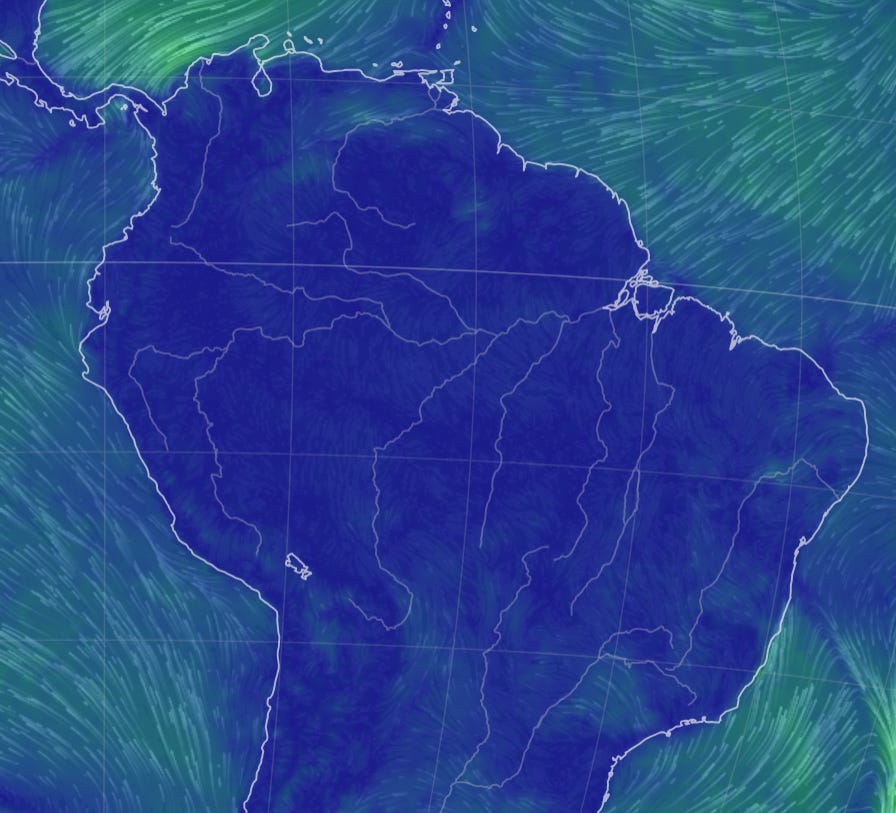
Surface winds above, winds at 5 km below
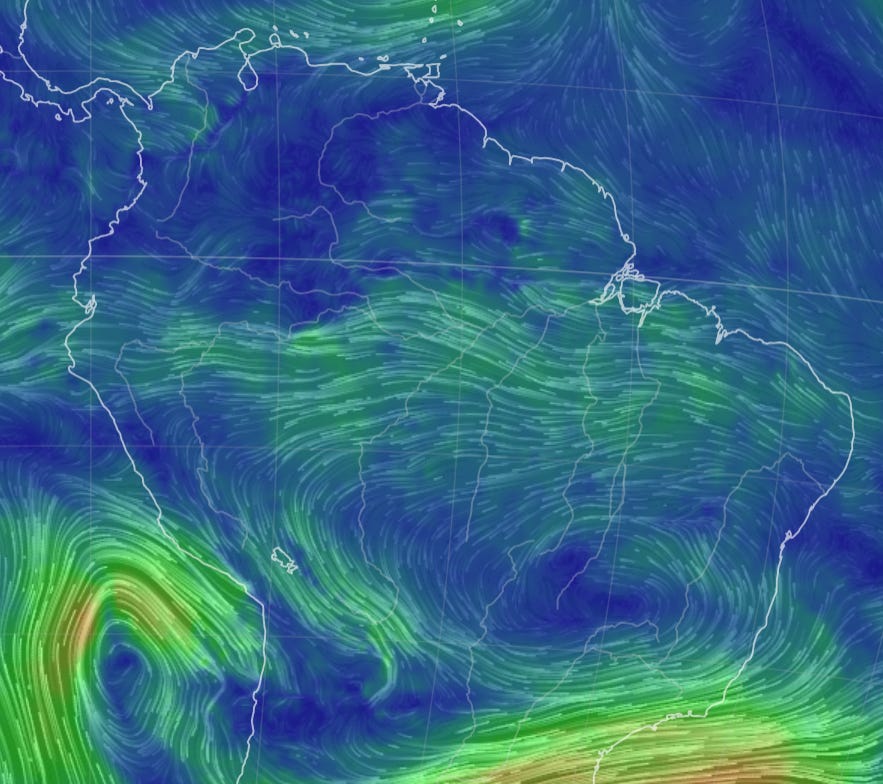
We can see that surface winds slow down noticeably as they enter the Amazon rainforest from the northwest. The air then ascends, generating precipitation (as shown in the previous section—note the intense rainfall around the mouth of the Amazon). At 5 km altitude, by contrast, winds are stronger over the forest than over the ocean, indicating that the ascending air continues its journey aloft before descending elsewhere.
Now let us take a look at Australia.
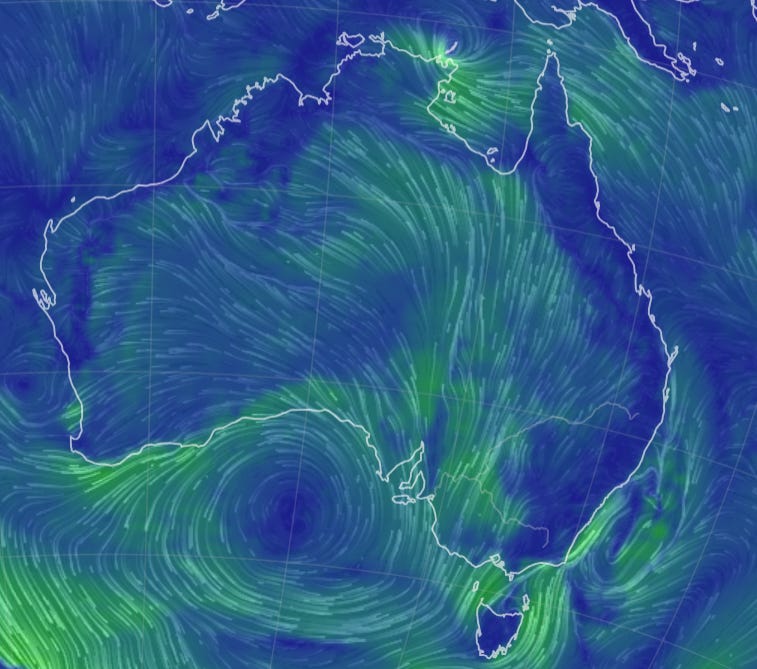
Surface winds above, winds at 5 km below
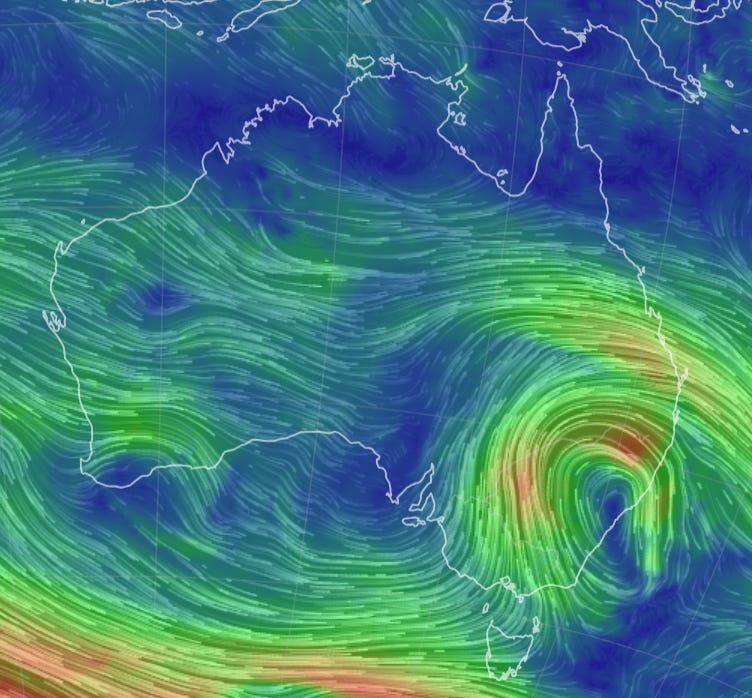
We can see that there is plenty of wind over the desert—about as much as over the ocean. But this wind does not bring rain. Notably, there is an anticyclonic pattern in the south of the continent, which is able to push air inland. In anticyclones, the air descends. In contrast, a cyclonic pattern in the southeast does not extend inland, keeping rains away from the once-devegetated continent.
To summarize, strong winds are not an indication of an efficient moisture import, while reduced wind speed over the forest compared to the ocean is a sign that precipitation is being generated.
How can forests stabilize precipitation?
Ndum Albert on LinkedIn commented as follows:
Fascinating explanation of the biotic pump theory! 🌳🌧️ As someone working in the Dja subdivision of Cameroon's East Region (Congo Basin), I've observed alarming changes that align with this - increasingly unpredictable rainfall patterns and rising daytime temperatures are severely impacting local farmers.
This makes me wonder:
1️⃣ Could our distance from the ocean be limiting the forest's moisture-pulling capacity as described?
2️⃣ Is rampant deforestation by timber companies disrupting these 'flying rivers', exacerbating climate variability?
The contrast between this theory and our lived reality suggests other compounding factors. I'd love to explore research on how forest fragmentation specifically impacts precipitation in inland tropical areas like ours.
Your insights would be invaluable - this knowledge could help us advocate for better forest conservation policies locally.
It so happened, historically, that the biotic regulation and biotic pump research originated in the Theoretical Physics Department of the Petersburg Nuclear Physics Institute. So let me use an analogy from nuclear physics.
If an atom like uranium-235 absorbs a neutron, it splits (this is called nuclear fission), releases energy, and produces more neutrons. Those neutrons can cause fission in other nearby atoms, so the chain reaction can continue and even accelerate, leading to an uncontrolled nuclear explosion. In nuclear power stations, one employs the so-called control rods — they are made of elements that absorb excessive neutrons, thus slowing down the chain reaction and taming nuclear energy so that it can be used peacefully.
Atmospheric condensation can be likened to a chain reaction. When precipitation occurs, it reduces atmospheric pressure, drawing in more moist air, which fuels additional precipitation. This feedback can escalate, driving wind speeds and rainfall intensity to extreme levels—as observed in hurricanes and tornadoes.
In this analogy, forest trees can be compared to sophisticated, self-regulating control rods that tame the energy of condensation to be used peacefully for the creative process of photosynthesis. Unlike rods in a power plant, forest trees are not manipulated by an operator but have evolved the necessary biochemical reactions and structural properties that allow them to generate mild, regular rains over the large territories they occupy. Even if there is a lot of rain overall, when it comes in mild events, it is not destructive.
P. Sillitoe (1993) gave an example of how safe the farming is under such conditions of protection by natural forests in Papua New Guinea:
First impressions suggest that the risk of soil loss through fluvial erosion from land under cultivation is considerable in the Southern Highlands Province of Papua New Guinea. The climate is very wet all year round, the terrain precipitous, and people regularly farm on steep slopes. The Wola-speaking people, who occupy a series of valleys in the centre of the province, and who practice a semi-shifting form of cultivation, are nonetheless off-hand about soil conservation and declare that erosion is not a serious problem. … The calculations suggest that, the steep slopes cultivated and wet climate notwithstanding, the local population’s assessment of the dangers of erosion is realistic and not reckless. Although rainfall is high, it is rarely of an intensity sufficient to threaten serious soil erosion losses. …
Below are the data from the work of Leite-Filho et al. 2021 who studied the effects of deforestation on long-term rainfall in Southern Brazil in 2001-2018.
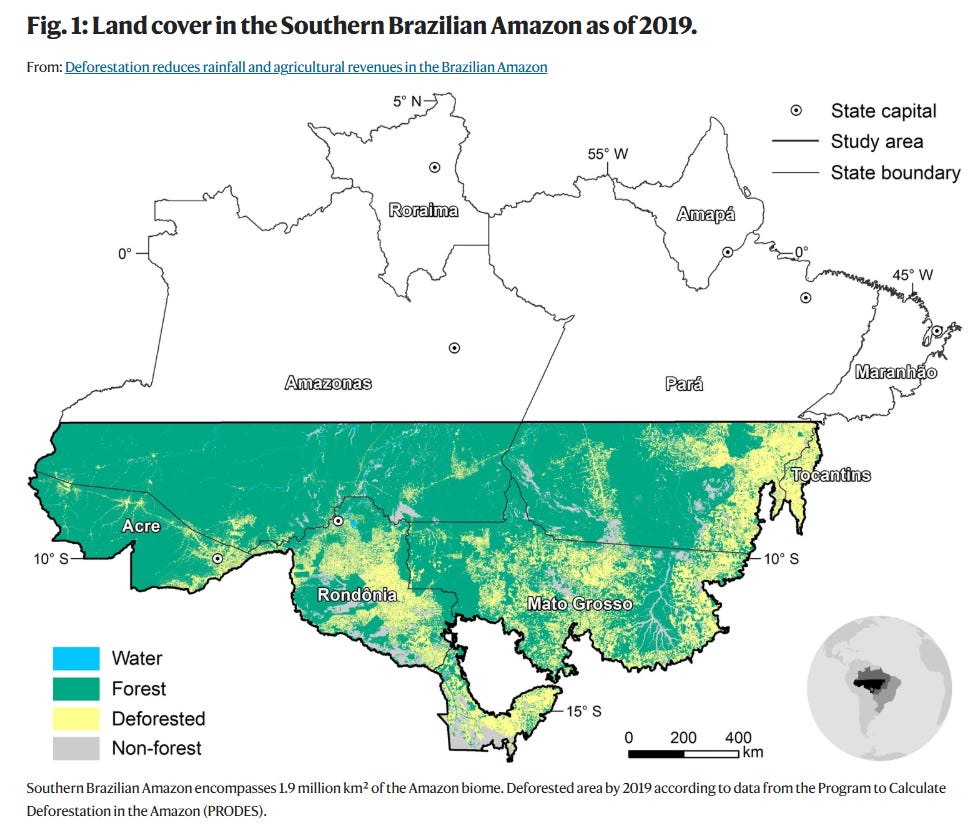
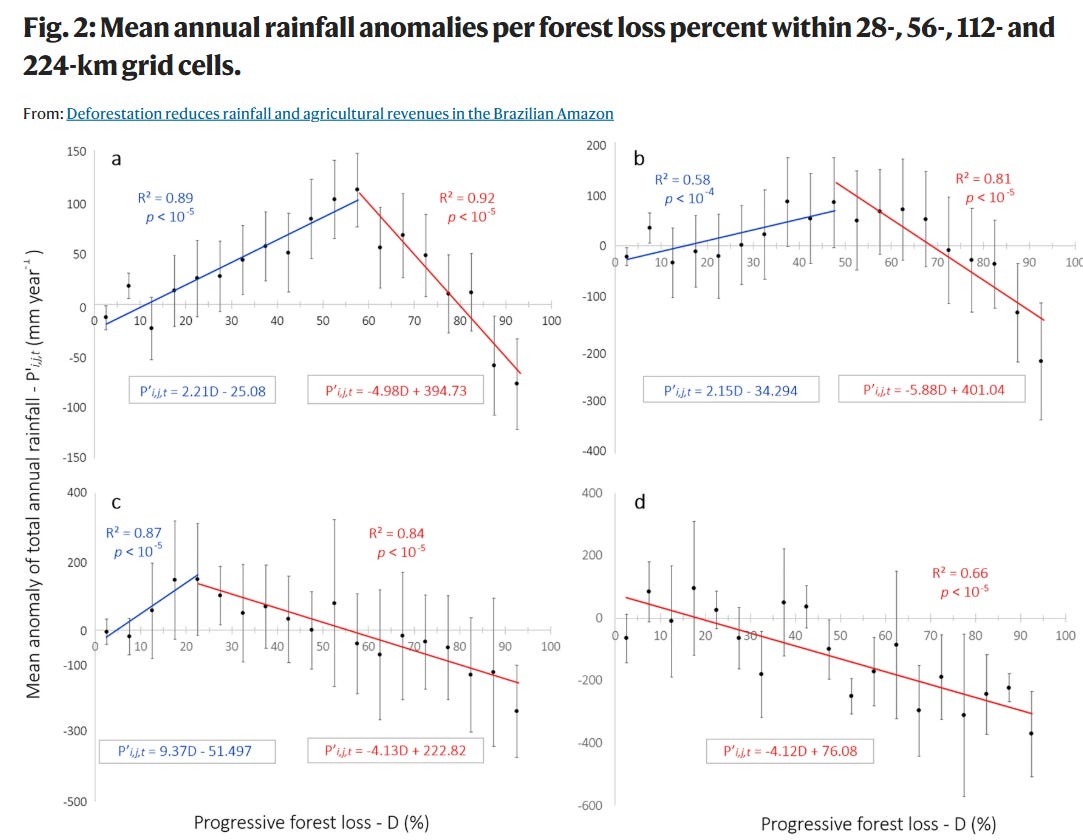
One can see that on a smaller scale, when one considers small grid cells (28 km by 28 km, panel a), precipitation tends to increase with the forest loss up to 50-60% of forest loss. However, on a larger scale (grid cells 224 km by 224 km, panel d), there is no such increase. This indicates a more erratic rainfall in deforested areas coupled with a general decline of precipitation in the region as a whole.
Deforestation, then, can be compared to removing control rods from the reactor of a nuclear power plant. This will, sooner or later, lead to a catastrophic and destructive release of energy. This is what we are seeing over deforested areas — while large-scale average precipitation declines, deforested landscapes—often marked by stark temperature gradients—experience more intense and erratic rainfall events, increasing the risk of floods and other hydrological disasters.
Can we restore vegetation to make land less fire-prone?
Amy Yates asked:
Do you think the small water cycle and eco restoration can play a major role in north western north america for reducing forest fires
Yes, I believe it can. However, it's important to keep in mind that a given landscape can have multiple stable states. For example, in Australia, we might consider a depauperate state with fire-resistant, non-tree vegetation, and a more luxuriant state with drought-resistant species, including large trees and shrubs—like those that supported tree kangaroos in the past.
What does it mean for these states to be stable? It means that after a minor or moderate disturbance, the ecosystem tends to return to the same state. For example, if trees are logged in a stable forest system, the tree cover may regenerate through natural succession.
But—and this is crucial—the depauperate state is also stable. If you simply plant a few trees in a degraded, dry landscape prone to fire (as much of modern Australia is), chances are those trees will not survive beyond the next fire.
This is the context in which the concept of "fuel load" has gained traction. When trapped in dry conditions (look up the notion of “landscape trap”), any additional vegetation can be seen as fuel—because dryness, too, is a self-reinforcing state.
You can think of the two stable states as being separated by a hill. Unless you can push hard enough to get the system over that hill, it will tend to roll back to where it started.
In practical terms, this means that efforts to restore the small water cycle and increase vegetation cover must begin with the understanding that early stages are fragile. A small plot won’t instantly become resilient. Extra effort, close observation, and sustained care are needed at the beginning. The more momentum you can build from the outset, the greater the chance of tipping the system over the hill—restoring a broader area to a more productive, wetter, and self-sustaining stable state.
It also matters greatly where you start—ideally by choosing meteorological “wet spots,” where precipitation reaches a local maximum, and then spreading restoration outward from there.
In summary, restoring the water cycle is extremely effort-intensive, requiring labor, education, and broad mobilization. Preserving ecosystems that are still functional must be our highest priority.
How is it that we cannot stop this global devastation? Who are we?
Further reading
https://bioticregulation.ru/pump
Leite-Filho, A.T., Soares-Filho, B.S., Davis, J.L. et al. Deforestation reduces rainfall and agricultural revenues in the Brazilian Amazon. Nat Commun 12, 2591 (2021).
Makarieva A.M., Gorshkov V.G. (2007) Biotic pump of atmospheric moisture as driver of the hydrological cycle on land. Hydrology and Earth System Sciences, 11, 1013-1033.
Makarieva A.M., Gorshkov V.G., Li B.-L. (2013) Revisiting forest impact on atmospheric water vapor transport and precipitation. Theoretical and Applied Climatology, 111, 79-96.
Makarieva A.M., Gorshkov V.G., Sheil D., Nobre A.D., Bunyard P., Li B.-L. (2014) Why does air passage over forest yield more rain? Examining the coupling between rainfall, pressure, and atmospheric moisture content. Journal of Hydrometeorology, 15, 411-426.
Makarieva A.M., Nefiodov A.V., Nobre A.D., Bardi U., Sheil D., Baudena M., Saleska S.R., Molina R.D., Rammig A. (2023) The role of ecosystem transpiration in creating alternate moisture regimes by influencing atmospheric moisture convergence. Global Change Biology, 29, 2536-2556.
And here the second question:
2. Long distance transport
The aforementioned and often produced diagram shows something like a single cell; say, if drawn at scale, perhaps 10-20km wide, half ocean, half land as well as perhaps 1-5km high. This demonstrates to me a biotic pump in operation in a coastal area only. Given that moisture is transported over thousands of kilometres at a certain latitude, what is the mechanism that moves moisture over long distance?
It would not sound plausible to me that a single pump moves air a low altitude using the prevailing winds all the way and the return path also for thousands of kilometres. Rather I could imaging that there are many "pumping cells" , alternating direction perhaps, but with a common group velocity defined by the prevailing winds. Do you have a model for that and a diagram that visualises the long distance transport of moisture.
If there is such a mechanism, i.e. a chain of pumping cells, which sounds quite likely, it then follows that it only needs a deforested area as wide as a cell is big, running perpendicular to the prevailing wind over a sufficiently large distance, the entire moisture transport would be compromised; downstream cells would be deprived of new moisture.
Dear Anastassia, over the past months I have been reading up on the Biotic pump as well been watching some videos and gradually I think I have gained some understanding. There are a few aspects I am not so sure about and thought here is a good place as any other to ask.
1. Keeping the pump going
Quite often there is the diagram showing moist air created by evaporation over the ocean being blown towards land (say by the prevailing wind, westerlies in the northern hemisphere), where it slightly rises, cools and condenses. In addition, if over forests, evapo-transpiration contributes to more rising moisture, i.e. even more moist air condenses. The result of this condensation is a) precipitation, b) radiation of latent heat into space, and b) a drop in pressure above said forest.
If that drop in pressure occurs at a certain altitude (where the clouds form, about 1-2000 meters?), wouldn't then air been drawn _into_ that area above the forest (at the height condensation occurs) from the surroundings (inland and from the ocean) rather than air flowing off to the ocean as shown in the diagram? The cycle would come to a stop shortly after the condensation occurs?
Perhaps exposing my ignorance here, but why does moist air after evapo-transpiration rise? One would think that moist air is heavier _unless_ energy (evaporation enthalpy) was imparted to the forest (through insolation for instance) in order to evaporate water, then more to decrease density and make moist air rise.